
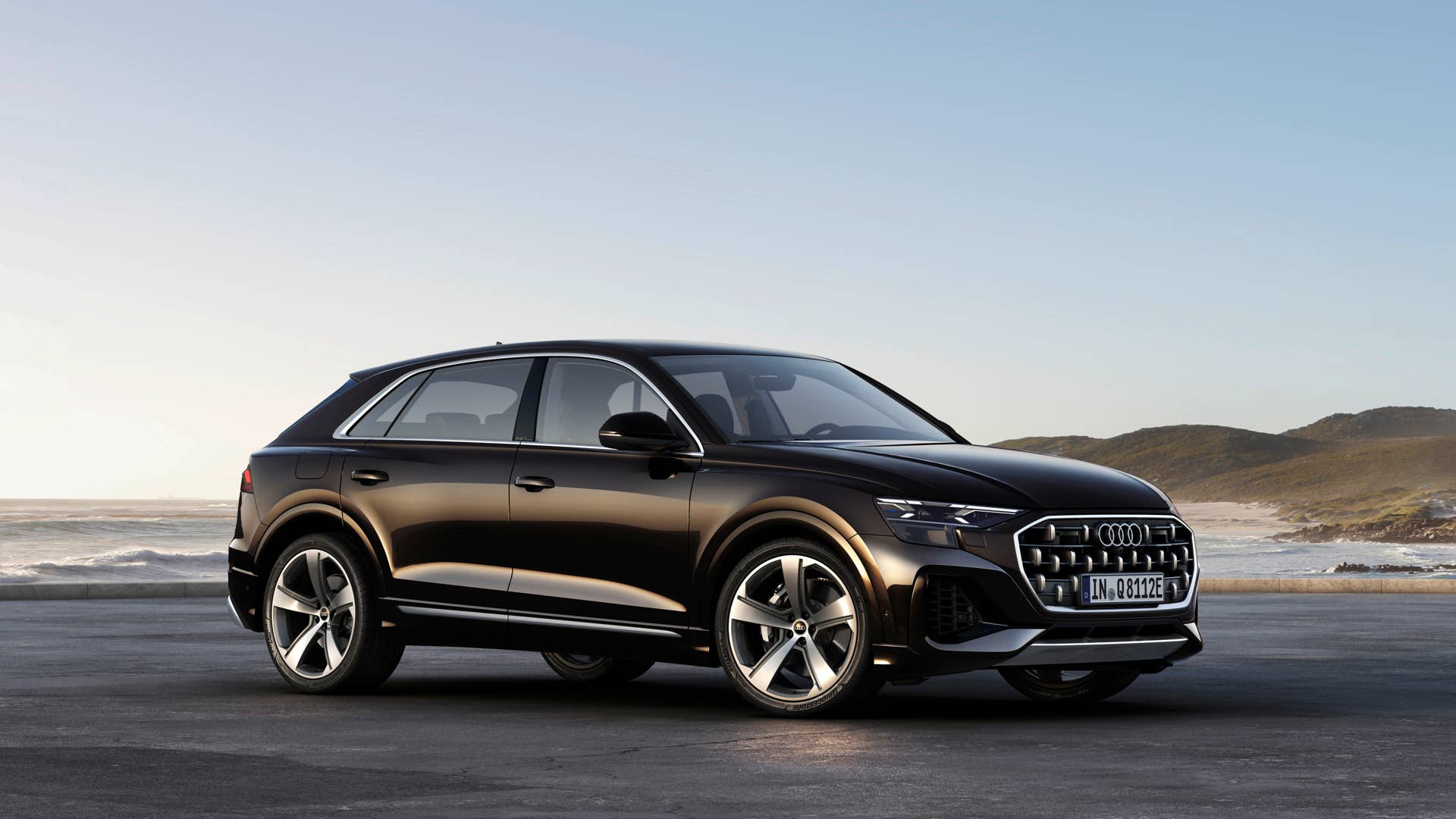
Featured Gallery

Static photo, Colour: Tamarind brown, metallic

Static photo, Colour: Tamarind brown, metallic

Static photo, Colour: Tamarind brown, metallic

Static photo, Colour: Tamarind brown, metallic

Static photo, Colour: Tamarind brown, metallic

Dynamic photo, Colour: Tamarind brown, metallic

Dynamic photo, Colour: Tamarind brown, metallic

Dynamic photo, Colour: Tamarind brown, metallic

Static photo, Colour: Tamarind brown, metallic

Interior

Interior

Interior

At the heart of the Q8 TFSI e quattro is a three-liter six-cylinder petrol engine with 250 kW (340 PS), a compact electric motor (PSM) with 130 kW maximum power, 460 Nm and the new, more powerful, liquid-cooled lithium battery.

On the combustion side, a three-liter six-cylinder petrol engine [250 kW (340 hp)] always works together with the compact electric motor (PSM) with a maximum output of 130 kW. The power unit is always coupled to an eight-speed tiptronic.

On the combustion side, a three-liter six-cylinder petrol engine [250 kW (340 hp)] always works together with the compact electric motor (PSM) with a maximum output of 130 kW. The power unit is always coupled to an eight-speed tiptronic.

The increased capacity of the new liquid-cooled battery results in a purely electric range of a maximum of 90 kilometers in urban areas according to WLTP EAER City, which corresponds to an electric range of up to 85 km according to WLTP EAER combined.

The increased capacity of the new liquid-cooled battery results in a purely electric range of a maximum of 90 kilometers in urban areas according to WLTP EAER City, which corresponds to an electric range of up to 85 km according to WLTP EAER combined.

Charging with up to 7.4 kW, the battery reaches 100 percent in around three hours and 45 minutes. Audi’s own charging service, Audi charging, provides access to around 630,000 charging points in 29 European countries on request.

Charging with up to 7.4 kW, the battery reaches 100 percent in around three hours and 45 minutes. The battery is actively cooled via a refrigerant circuit.

Charging with up to 7.4 kW, the battery reaches 100 percent in around three hours and 45 minutes. Audi’s own charging service, Audi charging, provides access to around 630,000 charging points in 29 European countries on request.

Cooling of the Q8 TFSI e quattro is ensured by a complex system comprising a condenser, low-temperature radiator and compressor, so that the car is always kept within the optimum operating temperature window for maximum efficiency.

The optional all-wheel steering, available for the first time for the Q8 TFSI e quattro, ensures an increased level of safety and comfort. The optional electromechanical active roll stabilization (eAWS) reduces body roll during sporty driving.
Audi showed the refreshed 2024 Q8 that’s coming to our market at the end of last October, and the refreshed 2025 Audi Q7 for U.S. consumption at the end of last month. Neither model made changes to its powertrains. In Europe, though, Audi’s just revealed two plug-in hybrid powertrains for the Q7 and Q8 that return the PHEV to the market. In 2019, the Ingolstadt brand announced the 2020 Q7 PHEV, but global production issues soon saw it pulled off the market when Audi had to prioritize components. The two new PHEVs pick up the banner and make big improvements on the last efforts.
There are two trims for each SUV, the 55 TFSI E Quattro and 60 TFSI E Quattro (that new naming structure will take hold eventually), both starting with Audi’s well-known twin-turbo 3.0-liter V6 making 335 horsepower and 379 pound-feet of torque over the Atlantic. Both also pack a 25.9-kilowatt-hour battery under the cargo floor (22 kWh usable). That’s not only larger than the previous 17.3-kWh battery, a more energy-dense chemistry and module configuration mean the pack doesn’t eat into load space. Pure-electric driving range rises from 26 to 53 miles in combined driving on the WLTP cycle, or as much as 56 miles using the WLTP’s new City standard. With a relatively low 7.4-kW charge rate, Audi says it takes 3 hours and 45 minutes to refill the pack from empty to 100%.
In the 55, a new electric motor that makes 174 hp and 339 lb-ft contributes to a total combined output of 389 hp and and 443 lb-ft. Because the motor is tuned more for driving dynamics, like filling in gaps during shifting and in turbo delivery, the 55 trim gets from zero to 62 miles per hour 0.1 second behind the gas-only versions. In the 60, a new electric motor with a more powerful tune takes combined output up to 483 hp and 516 lb-ft., dropping the 62-mph dash to five seconds flat. Both trims are limited to a top speed of 150 mph when in Hybrid driving mode, or 84 mph in EV driving mode.
Audi tuned the powertrain so owners can choose what mode the vehicle starts in — EV or Hybrid — that choice maintained until the owner changes it (a feature we’d love to see on a few cars over here). In Hybrid mode, an auto setting lets the powertrain decide how to deploy battery power and electric motor assistance, a hold setting keeps the battery pack at its current level using a mix of engine power and regenerative braking, and a charge mode restores the battery to 75% full “to conserve the battery and increase efficiency.”
The 55 and 60 variants come pretty well stocked, standard kit including the S line exterior package, LED headlights with high beam assist, wheel designs from 19 to 21 inches and optional wheels up to 23 inches, nine decorative inlays for the cabin, contrasting seat stitching, and a charging cable. The 60 comes with a standard air suspension as well, an upgrade from the 55’s steel springs.
Available to order now in Europe, we don’t expect either to make it this way, same as the previous PHEVs. The Q5 is as high as it goes for plug-in Audi SUVs here.
Related video: