
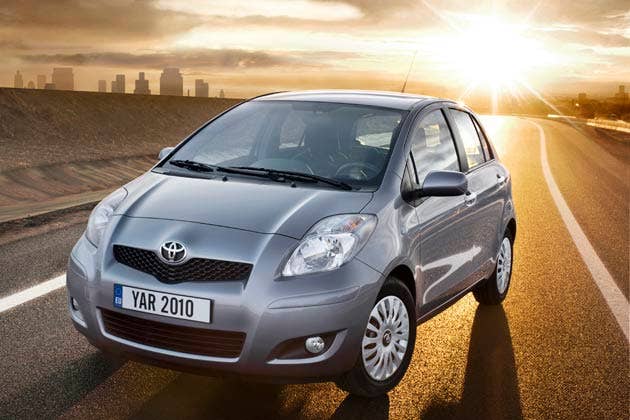
2010 Euro Toyota Yaris – Click above for high-res image gallery
When a model has moved two million units in 10 years, you want to tread lightly when considering changes. This explains why despite the ballyhoo, we don’t see a whole lot different with the 2010 Toyota Yaris. The small, efficiently packaged Yaris is Toyota Europe’s best seller, so it’s certainly understandable that changes for 2010 amount to new bumpers and tweaks to the exterior lamps. There are new wheels, matte-finished door handles and a two new colors, as well. Inside, the refresh includes new gauges, standard air conditioning and… not much else.
However, more has gone on under that stubby little hood, with every Yaris now available with one of three engine options. Two gasoline engines, 1.0- and 1.3-liter fours, and a 1.4-liter diesel, all tweaked-up for efficiency and to reduced carbon dioxide emissions. The 1.3-liter gets stop/start, while the diesel uses piezo injectors, a variable-nozzle turbocharger, and a generator that can decouple. Can you smell the excitement now?
Still, the results of the fiddling will make the Yaris more attractive on the fuel-consumption tip, while also keeping after its looks like a 40 year old that still dates. North American buyers can rest assured that the D-4D and its fuel economy equal to roughly 57 miles per gallon will never land on these shores. In fact, what’s most likely is the powertrains will stay put while the cosmetic upgrades head our way. After all, the U.S. market Yaris is a veritable hot rod with its 1.5-liter four-pot. Hit the jump for the press release.
[Source: Toyota]
- Yaris, Toyota’s best selling model in Europe
- Toyota Optimal Drive technology across the entire engine range
- New grade Yaris 2010 brings added visual appeal and product value to the heart of the model range
Driven by a greater demand for small, fuel-efficient cars, the B segment’s share of
the overall market is on the increase. In 2009, it grew from 21 % to 23 %, further
establishing its key position within the European automotive market.
First launched in 1999, with an all-new, second generation model introduced in
2005 and further refinements added in 2009, the Yaris is Toyota’s best selling
model in Europe, positioned at the heart of this highly competitive segment.
As reflected in its consistently strong performance in the European J.D. Power
Customer Satisfaction survey, an ever-increasing number of customers have
come to appreciate the Yaris’ ingenious packaging, class-leading passenger room
coefficient, comfort and versatility, advanced technology and performance. In
total, over 2.2 million units have been sold across Europe since its launch, and the
Yaris represents a quarter of Toyota’s annual car sales on the continent.
In 2009, Toyota Optimal Drive technology was introduced across the entire engine
range. This has significantly lowered both fuel consumption and CO2 emissions,
with appreciable cost of ownership benefits to customers. All engines – 1.0 litre
VVT-i, 1.33 litre Dual VVT-i and 1.4 litre D-4D – now generate 120 g/km or less,
with fuel consumption averaging below 5 l/100 km.
Yaris 2010 introduces a new grade into a revised, streamlined model line-up which
sees all engine variants available in every grade. Bringing added visual appeal
to the heart of the model range, Yaris 2010 features numerous exterior styling
updates, a refreshed interior and an upgraded standard equipment specification.
Manufactured at TMMF Valenciennes in France and on sale from January 2010,
the new Yaris 2010 will revitalise the core of Toyota’s best-selling European
model, with overall range sales expected to exceed 200,000 units in 2010.
New feature model: Yaris 2010
- Yaris 2010 – a new grade at the heart of the model line-up
- Refreshed interior and exterior design
- Upgraded standard equipment specification
- Enhanced product value with up to 5 % customer benefit
Yaris 2010 is a new grade at the heart of the model line-up, replacing the outgoing
feature model. The revised model line-up now comprises four specification levels:
Base, Luna, new Yaris 2010 and Sol.
Designed to refresh the model’s advanced, innovative image, and add further
visual appeal to Toyota’s popular B segment hatchback, Yaris 2010 benefits from
several exterior updates.
It now features a more expressive, tinted headlamp cluster design, newly
developed matt silver door handles, a new modern wheel cap design as well as
new alloy wheels, a new rear light colour treatment and two new, grade-exclusive
exterior colours; Light Purple Silver and Blue metallic.
On board, the Yaris 2010 standard equipment specification has been enhanced
to include analogue instrument dials, a perforated leather steering wheel and
gearshift knob, and a distinctive upholstery trim.
With automatic air-conditioning and front foglights also incorporated in the
standard equipment specification, the Yaris 2010 offers a customer benefit of
up to 5 %.
Toyota Optimal Drive
- All Yaris 2010 engines feature Toyota Optimal Drive
- All three engines generate under 120 g/km
A choice of three powerplants – 1.0 litre VVT-i and 1.33 litre Dual VVT-i petrol
units and a 1.4 litre D-4D – is now available across the entire Yaris model range.
Every engine benefits from the performance – and economy-enhancing benefits of
Toyota Optimal Drive and, from July, will comply with Euro V emissions standards.
As a result, all three engines generate under 120 g/km, with model range fuel
consumption averaging below 5 l/100 km. Moreover, Yaris whole-fleet CO2
emissions will be reduced from 130.8 g/km in 2008, to 117.4 g/km in 2010.
Designed to maximise performance and driving enjoyment while minimising
fuel consumption and CO2 emissions, Toyota Optimal Drive focuses on several
key aspects of powertrain development such as lightweight, compact design,
enhanced combustion efficiency, low friction components and environmentally
friendly technologies.
Petrol engine combustion efficiency has been improved through the use of a high
efficiency intake port, a high compression ratio and long reach spark plugs. The
1.4 litre D-4D benefits from the adoption of a lower compression ratio, optimised
combustion chamber dimensions, enhanced Exhaust Gas Recirculation (EGR)
cooler efficiency and a stainless steel exhaust manifold with an optional, closecoupled
Diesel Particulate Filter (DPF).
Environmental technologies are represented by the application of Dual VVT-i
and Stop & Start technology to the 1.33 litre Dual VVT-i petrol unit, while the
1.4 litre D-4D engine is equipped with next generation Piezo injectors, variable
nozzle turbocharging, a de-coupling generator and new, electrical Exhaust Gas
Recirculation.