
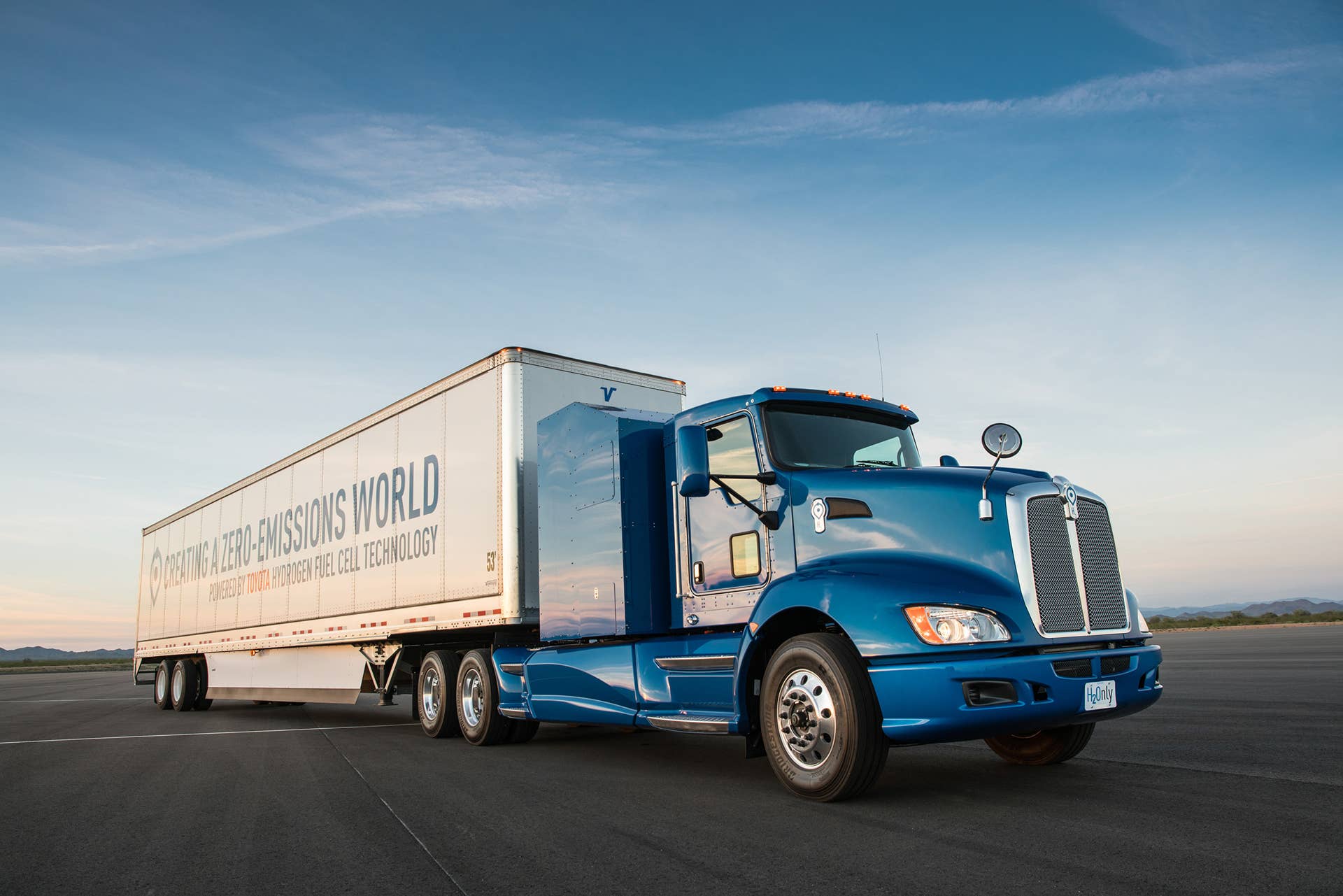
Toyota is planning to put hydrogen fuel cell technology to use in heavy duty trucks. At a press conference, Toyota announced it will experiment with zero-emission trucks at the Port of Los Angeles, calling the proof-of-concept system “
Project Portal.” The feasibility study will also benefit the port’s Clean Air Action Plan.
The idea is to provide the sort of performance that is expected from trucks handling short-distance ground freight work. Heavy duty vehicles are responsible for a large portion of the port’s emissions, but they are crucial in the port’s operation. Toyota’s concept truck uses two Mirai fuel cell stacks and a 12-kWh battery and produces over 670 horsepower and 1,325 pound-feet of torque, with a driving range of 200 miles. Despite using such a diminutive powertrain – for a truck application, anyway – the Project Portal truck can haul 80,000 pounds of cargo in its daily drayage operation.
In Japan, Toyota has already experimented
with similar buses. Toyota’s commitment to fuel cell technology is steadfast, and it was recently announced that the manufacturer will partner with Shell to increase the number of hydrogen fill-up stations in California. And as fuel cell vehicles spend a relatively short time filling up compared to an electric vehicle charging, a fuel cell setup makes sense in an industrial implementation such as a major city’s port.
“Toyota believes that hydrogen fuel cell technology has tremendous potential to become the powertrain of the future,” says Toyota Motor North America’s Bob Carter. “With Project Portal, we’re proud to help explore the societal benefits of a true zero emission heavy-duty truck platform.”
Related Video:
Video ID:
282b7db0-c949-3be5-a26e-3314ef730608
Playlist ID:
Autoplay:
false
Mute:
false
Continuous:
false
Ad Key:
Ad Value: