
To paraphrase Mark Twain, rumors of the grid’s demise on account of more plug-in vehicles are greatly exaggerated. And, while time is money, when it comes to electric-vehicle charging, more money means less time. At least, less time during peak demand.
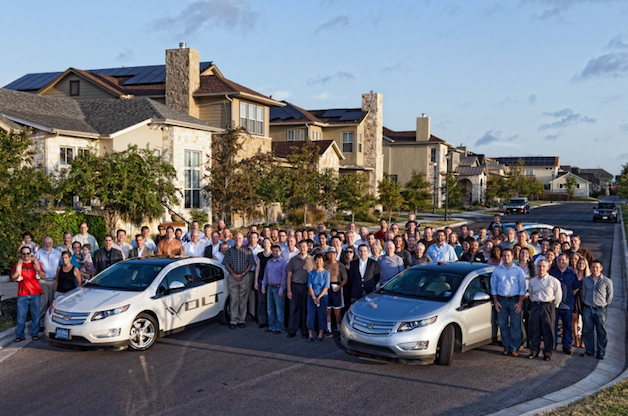
Plug-in vehicle owners in a cluster of Austin, Texas homes were used as a charging-behavior test group, and the early returns say that those households didn’t put much of a stress on the local power grid. And that’s even during peak-use summer afternoons when air conditioning units in central Texas tend to be set to full blast, Midwest Energy News says, citing a report from Pecan Street Research Institute. The test included 21 Chevrolet Volts, nine Nissan Leafs and a solitary Tesla Model S. Of course, make ’em all Teslas and we might have a different story.
Additionally, half of those 30 vehicle owners were also part of a test in which the electricity price was adjusted to reflect peak demand times. Not surprisingly, those car owners were about half as likely (about 12 percent of those) to plug-in during peak hours as the ones whose prices weren’t being adjusted (about 22 percent). Regardless, the average cost of electricity used by those vehicles per month came out to $23.56, or the equivalent to about half a tank of gas. Yee-haw, indeed.