
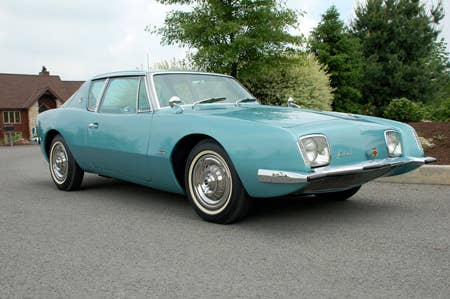
Click the image above for more high-res pics.
During a recent excursion back east, we had the opportunity to be in the presence of one of the most iconic automobile designs of the 20th century: the Studebaker Avanti. Worshiped by some and derided by others, Raymond Loewy’s masterpiece was two-and-half steps beyond anything produced in the ’60s. The coupe’s name itself means “forward” or “advance” in Italian, and whether you’re smitten by the Avanti’s aerodynamic styling or its innovative approach to safety, there’s a little something for any purebred pistonhead.
This particular 1964 supercharged R2 example currently resides outside Pittsburgh, PA, under the watchful gaze of its owner, John Kudravy, who is a family friend, architect, design snob and devout worshiper at the altar of power and poise. He’s owned the Avanti for going on two decades and after showing it at several events across the U.S., it’s likely to be the best-kept Avanti in North America.
For a brief rundown on the Avanti, you can check out Wikipedia’s entry here, along with a bio of Raymond Loewy here. And be sure to check out our 40-image-strong gallery below.
A special thanks to John for his time, expertise and patience, along with his early contribution to our obsession with all-things automotive.
Featured Gallery

Koenigsegg introduced its CCX hypercar to the world at the 2006 Geneva Auto Show. The CCX ships with a massively powerful dual-supercharged 4.7-liter V8 engine producing 806 hp and 678 lb-ft of torque. In order to achieve those impressive figures, Koenigsegg designed and built the motor themselves. Performance is on the comical side of baffling with 0-60 mph happening in 3.2 seconds and an unverified top speed of 259 mph. More impressive perhaps, is the CCX’s ability to go from 0-186-0 in 29 seconds.
- More on the Koenigsegg CCX
- Koenigsegg CCX Overview
- Koenigsegg CCX Video Test Drive
- More Koenigsegg CCX Photos
Made in Sweden, the CCX differs from some of its European counterparts such as the Pagani Zonda by being intended for the American market. As a result, the Koenigsegg CCX runs on readily available 91 octane gas, meets tough U.S. crash regulations and tougher California emissions standards. Owners can expect about 14 miles per gallon in mixed driving. And unlike cars built without the U.S. in mind, the CCX can take an American regulation license plate.
- More on this Swedish Supercar
- Koenigsegg CCX Overview
- Koenigsegg CCX Video Test Drive
- More Koenigsegg CCX Photos

Out of either a concern for the U.S. market or the planet, in 2008 Koenigsegg introduced the “green” CCXR. Not only does the Koenigsegg CCXR run on corn-based E85 (or E100), but the environmentally friendly hypercar is actually more powerful than the normal car, producing a Bugatti Veyron rivaling 1,018 hp and 782 lb-ft of torque. And if Koenigsegg’s top speed claim is ever verified, the CCXR would be the fastest production car in the world. A Koenigsegg CCX was clocked at 241 mph, breaking the long time record of the McLaren F1 as the fastest production car in the world before being dethroned by the 253 mph Bugatti Veyron.
- More on the Koenigsegg CCX
- Koenigsegg CCX Overview
- Koenigsegg CCX Video Test Drive
- More Koenigsegg CCX Photos

The CCX’s price tag, like its power and performance, is simply staggering. Depending on the exchange rate you can expect to pay around $550,000. Still, compared to competition in the hypercar realm the Koenigsegg CCX is a relative bargain. Both the Bugatti Veyron and Lamborghini Reventon retial for $1 million more. Even the 257 mph SSC Ultimate Aero TT costs $100,000 more. And yes, buying cars that cost as much as nice houses is ultimately silly.
- More Supercars
- Bugatti Veyron
- Lamborghini Murcielago
- Mercedes SLR McLaren

We also find the Koenigsegg CCX to be beautiful, elegant in a way that other uber-sports cars are crudely aggressive. It never screams, “Look at me!” the way certain Italian cars do. Blame it on inherent Scandinavian restraint, though it’s a welcome change of supercar pace in our book. Good looks, mega-performance, bragging rights and gas mileage on par with a Cadillac Escalade, the Koenigsegg CCX offers the extremely wealthy car enthusiast a lot to love. If you have the means, by all means…
- More on the Koenigsegg CCX
- Koenigsegg CCX Overview
- Koenigsegg CCX Video Test Drive
- More Koenigsegg CCX Photos