
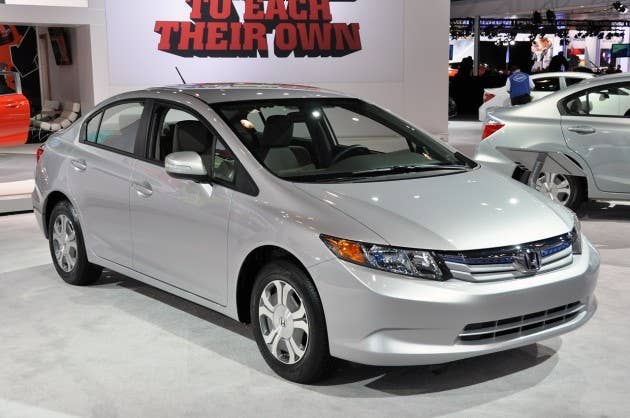
2012 Honda Civic Hybrid – Click above for high-res image gallery
The 2012 Honda Civic Hybrid is officially rated at 44/44/44 city/highway/combined, but the folks over at Hybrid Cars have squeezed 68.7 mpg out of their test unit.
By using some hypermiling techniques on a ten-mile course consisting of country lanes, some light highway motoring and with a handful of stoplights along the route, Hybrid Cars achieved what it calls the “upper limit” of what any 2012 Civic Hybrid driver should expect in terms of fuel economy. At an impressive 68.7 mpg, the Civic Hybrid is certainly a fuel-sipping vehicle if driven using some gas-saving techniques, but the real fuel economy tests will come when everyday Joes slot in behind the wheel and pilot Honda’s hybrid sedan under more “normal” driving conditions. Until then, let’s just say that the fuel economy rating of the 2012 Civic Hybrid slightly improves upon the 40/43/41 numbers sported by the 2011 model.
Featured Gallery

As she prepared to introduce the 2015 Lincoln MKC at a press conference, a colleague’s remarks caught Lisa Drake, the car’s chief program engineer, off-guard.
Better know the Escape’s specs, the colleague advised.
“The Escape?,” Drake said. “Why?”
She was dumbfounded.
Lincoln’s recent vehicles look so much like their more mainstream vehicles produced by Ford, even company insiders think the vehicles are near twins. It’s a problem that strikes right to the core of Lincoln’s recent problems, ones the company needs to overcome if it wants to be taken seriously as a luxury brand.
Here’s a peek at the MKC, a vehicle that needs to succeed.

It will take time for the car-buying public’s perception of Lincoln to catch up with the reality that Drake has spent her time differentiating her vehicle from the Mercedes-Benz GLK, the Audi Q5 and the BMW X3 and not differentiating it from the Escape.
In theory the MKC, which has been in development for more than four years, is Lincoln’s best chance at regaining traction in the luxury-car marketplace: It’s an all-new entry in a growing sales segment.
Based on seeing it in person, but without being able to drive it, the car seems like it could be a contender. Lincoln introduced the vehicle at an event last week to select members of the media, and it appears almost identical tothe concept shown at the North American International Auto Show earlier this year.

When it goes on sale next summer, its starting price of $33,995 will be enticing to consumers who find it comparable to the BMW X3, which starts at $39,800, the Audi Q5 ($37,300), and the Mercedes-Benz GLK ($37,480). It’s potentially a good value proposition.
“I don’t like the word ‘value,’ though,” Drake said. “You don’t drive a luxury car for value.”
An all-new turbocharged engine designed specifically for Lincoln is available on the MKC. It is a 2.3-liter, four-cylinder EcoBoost that produces 275 horsepower and 300 pound-feet of torque. A 2.0-liter that produces 240 horsepower comes standard. Fuel economy numbers for either have not yet been determined.
The usual technology package suspects are offered, but one notable addition on the MKC is a new park-out assist system, a class-exclusive feature. Most park-assist features help drivers back into tight spots; Park-out does what you’d imagine. It helps drivers exit those same tight spots.

On the inside, the telematics unit at once offers a return to the past and a peek into the future. Motorists will be empowered with the ability to spy –- or check up on, if you prefer -– their spouses and wayward teenagers with a bread-crumbing program that allows them to see where the car has traveled.
They’ll control that function -– and more basic ones, like the radio and climate control -– with knobs and buttons that complement the touchscreen. It marks a welcome retreat from the all-touchscreen approach that caused much frustration and outrage among previous MyFord Touch and MyLincoln Touch users.
“To be honest, I don’t think the technology is quite ready yet,” said Max Wolff, director of Lincoln design. “For the moment, people want to get into their cars and press a button, then turn a knob.”
There’s enough room for adult passengers in the rear seats, though no one would make the mistake of calling them roomy.

Built on Ford’s global C1 platform at its Louisville, Ky., assembly plant, there are certainly subtle signs on the outside of some distant relations to the Escape. But there’s no real striking resemblance. The MKC has a higher beltline and sits more on its haunches. It also has an intricate, custom-designed rear liftgate that extends around the sides of the car that engineers spent months designing and ultimately used a new stamping technique to create.
“We had to have something that was out of the ordinary, something that draws your eye as far out as possible,” Wolff said. “At first they said, ‘This won’t even be possible.’ They couldn’t use traditional die casting.”
If the rear-view helped the MKC stand apart from the Escape, better yet, it helped it stand out from the Lincoln lineup.

For a brand seeking to reinvent itself, the MKC is an encouraging product in that it is an acknowledgement that big changes are needed.
“We’re not naïve, and we know we have to fix elements of the Lincoln business,” said Matt VanDyke, Lincoln’s global director. “People have been in luxury and scaling down to smaller cars. They’re not equating size with luxury anymore. [With] this car, they’re getting an opportunity to downsize.”
Pete Bigelow is an associate editor at AOL Autos. He can be reached via email at peter.bigelow@teamaol.com and followed on Twitter @PeterCBigelow.
Live photos copyright ©2011 Drew Phillips / AOL
[Source: Hybrid Cars]