Fedex to develop and test hydraulic series hybrid delivery van

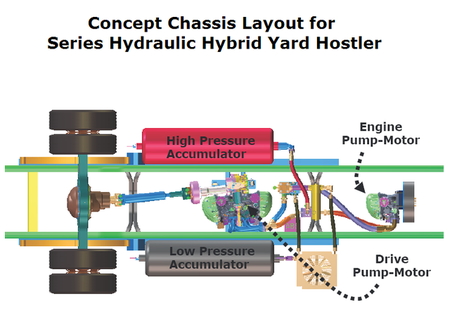
Fedex Ground is teaming up with hydraulic component manufacturer Parker Hannifin to develop and field test a hydraulic hybrid delivery van. The van will use a series hybrid layout similar to one developed by FEV that is being tested by UPS. The internal combustion engine will drive a hydraulic pump which will generate pressurized fluid to drive a hydraulic motor-pump. The second motor-pump will drive the rear axle. Under braking, the rear axle will drive the motor-pump to charge a high pressure hydraulic accumulator, capturing kinetic energy. During acceleration, the high pressure accumulator can provide driving force to the motor-pump to move the truck. The hydraulic hybrid setup has the advantage of being able to absorb energy more quickly than a battery, recapturing up to seventy percent of the kinetic energy compared to thirty percent for a typical battery. Unfortunately the capacity is limited. However it works well for this type of application that has a lot of stopping and starting and low speeds. The prototype is expected to be ready for testing by Fedex sometime in 2008.

Get Autoblog in your Google feed

Fedex Ground is teaming up with hydraulic component manufacturer Parker Hannifin to develop and field test a hydraulic hybrid delivery van. The van will use a series hybrid layout similar to one developed by FEV that is being tested by UPS. The internal combustion engine will drive a hydraulic pump which will generate pressurized fluid to drive a hydraulic motor-pump. The second motor-pump will drive the rear axle. Under braking, the rear axle will drive the motor-pump to charge a high pressure hydraulic accumulator, capturing kinetic energy. During acceleration, the high pressure accumulator can provide driving force to the motor-pump to move the truck. The hydraulic hybrid setup has the advantage of being able to absorb energy more quickly than a battery, recapturing up to seventy percent of the kinetic energy compared to thirty percent for a typical battery. Unfortunately the capacity is limited. However it works well for this type of application that has a lot of stopping and starting and low speeds. The prototype is expected to be ready for testing by Fedex sometime in 2008.

[Source: Parker-Hannifin, via Green Car Congress]