
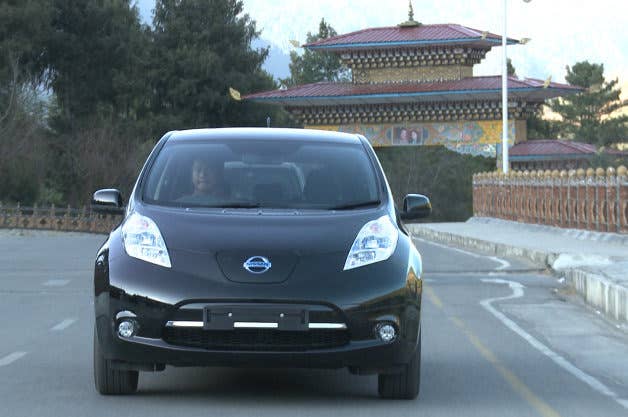
Originally, the somewhat modest plan was to introduce 2,000 electric vehicles to the capital of Bhutan. Then things got bigger when Renault–Nissan CEO Carlos Ghosn paid the country a visit and the Prime Minister of Bhutan, Tshering Tobgay, said his country, “will commit to a program to achieve zero emissions as a nation by a certain target date.” Now we’re approaching “holy huge” territory. Last week, Tobgay visited Japan to ask Nissan and Mitsubishi for help in possibly replacing every combustion vehicle with an all-electric option.
“Gasoline is expensive and unfriendly to the environment.” – Bhutan’s Prime Minister
At the very least, Bhutan wants to make more eco-friendly vehicles available. Tobgay told AsiaNews that, “Gasoline is expensive and unfriendly to the environment. Sustainable transportation will bring citizens happiness,” which is something that a country that measures its Gross National Happiness is eager to track.
Switching to electric vehicles makes complete sense in Bhutan, since the mountainous Asian nation produces more renewable hydro-electricity than it can use. Ninety-five percent of the zero-emission energy is exported to India, and Bhutan uses the profits to buy fuel from India to then power its vehicles. You can probably figure out for yourself how there’s a simpler way to do this.