
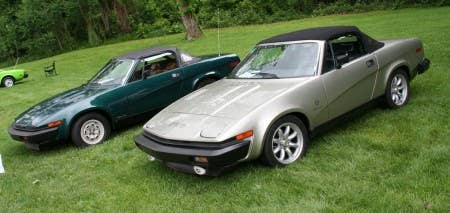
Last of the Triumph line. A pair of remarkably rust free TR8s
We already showed you the American contingent at the Orphan Car Show in Ypsilanti, MI a few days ago but it wasn’t a completely domestic show. Over the years, there have been many carmakers who have brought their funky machines to our market before finally succumbing to the pressure. Many of them are still in business in their home markets and some, like Peugeot/Citroen, are even thriving.
And then there’s British Leyland. During the fifties and sixties, most of the larger British car companies were subsumed into a government-owned mass known as British Leyland. By the 1980s under the Iron Lady, after several of the brands had already become defunct, the rest were ultimately sold off. Some, like Land Rover and Mini have gone on to success, while Jaguar has struggled on and Rover ultimately whithered.
More orphaned furriners after the jump
Featured Gallery

The minivan category was once solidly owned by Detroit. Chrysler dominated, having invented the minivan in the early 1980s. Add in General Motors’ and Ford’s minivans, and MoTown had the lion’s share of the lucrative Mom-van market.
But GM abandoned theminivan market in 2007, replacing its vans with full-sized crossovers including the Buick Enclave and GMC Acadia. Ford gave up on the minivan market in 2006, choosing to emphasize SUVs. Chrysler has been holding the line as the market leader, but could lose its mantle this year to the Honda Odyssey.
If it comes to pass, it would be a turning point in that the two traditional U.S. family vehicles–the four door sedan and the minivan–would be led by Asian brands in America. Toyota has long held the lead in the sedan market with the Camry.
At the Los Angeles auto show this week, though, Chrysler, as well as Ford, are trying to juice up the minivan category with fresh offerings.

Chrysler showed off its version of the Chrysler Town & Country, marking Chrysler’s attempts to make a minivan that might appeal to younger buyers. And if younger buyers don’t bite, then maybe it will appeal to more stylish people.
“We tailored the new Town & Country S for the active and style-minded consumers,” said Saad Chehab, president and CEO of the Chrysler group. Chrysler’s efforts at sprucing up the Town and Country image are worth a shot. Although there’s not much automakers can do to revive the minivan segment, when they make an effort to make the big family haulers appear more trendy, sales tend to go up.
After Honda redesigned its Odyssey minivan in 2011, critics loved what they called a”lightning bolt” design on the side. If it weren’t for the fact that supplies were constrained after last year’s tsunami in Japan, the Odyssey would have been the No. 1 selling minivan in the United States.
In 2010 Toyota tried to make minivans cool again with a set of commercials, in which a mom and dad rapped about their”swagger wagon.” It became a viral hit, and it helped sales, too. Sienna sales rose 13 percent in 2011.

It may be a reach to describe a minivan this way, but the new Town& Country S is going for that “little black dress” look. It comes with a black chrome grill with a black-background Chrysler badge, and black-out headlight bezels. It also comes in colors special to the S: Brilliant black, deep cherry red, stone white or billet silver.
Under the hood, the”mom-van” gets a performance suspension to try and make it feel more like a sports car, Chrysler says. It comes with a 3.6-liter Pentastar V-6 engine, pumping out 283 horsepower and 260 pound-feet of torque. A fuel economy mode could help it get better fuel economy — which you might need, because it gets just 17 mpg in the city and 25 mpg on the highway.

On the inside, Chrysler is trying to stick with the black theme. The seats are black leather with an”S” logo embroidered on the backs. There’s also grey stitching on the seats and arm rests, and the instrument panel is glossy black.
Chrysler has also put a new Blu-Ray DVD system in the back with HDMI inputs, which lets passengers in the back watch high-definition movies or play video games on the go. Blissfully, these systems also come with wireless headphones, so the driver doesn’t have to listen in.

While minivan sales have gone up 17-percent so far this year, according to AutoData, that’s only because car sales in general are rising (by 13.8 percent year to date). But minivans sit on dealer lots eight days more than other kinds of cars, data from J.D. Power shows. Why? Many parents feel the need to move on from the sliding doors after owning one, and others, with just one or two kids, opt for crossovers like Ford Escape, Subaru Outback and Honda CR-V instead of a van.
Ford is trying to make a re-entry into the minivan market, but they hope some wordplay and marketing will keep people from realizing their newFord Transit Connect Wagon is really a minivan. Ford prefers we call it a “?People Mover.” That’s unfortunate as “people mover” is the name of the highly unsuccessful, and often ridiculed elevated train in downtown Detroit. Ford is hoping for better success.

Ford abandoned the minivan market in 2006 when it discontinued the Ford Freestar. It recently showed off the new wagon at the Los Angeles auto show, hoping to make a splash there for the normally languid minivan category.
Ford is touting the Connect as the most fuel-efficient seven-passenger vehicle on the market. The automaker is banking on the hypothesis that people will move away from traditional minivans due to fuel-economy concerns. But without automatic sliding doors that parents with child-seat riding kids value, we aren’t so sure. Could this be the new van for empty-nesters?
Why no automatic sliding doors? They add cost and weight, and the heavier a vehicle, the more gas it tends to consume. Still…
The Italians (aside from Ferrari) and the French struggled in the US market until the late eighties when they finally packed it in. Like BL in Blighty, the Agnelli family in Turin absorbed most of the auto industry in the boot peninsula, and like the Brits, labor issues in the plants led to a completely contemptuous attitude toward quality control. As a result, even some of those who’ve never actually seen a Fiat may have heard “Fix It Again Tony.”
While many of the Italian cars were at least aesthetically pleasing, the French were another story. As in so many other areas, when it comes to car design, the French seem to insist on being different just to be different. And speaking of different, long before there was Smart, there was Isetta. The front panel of the car is hinged on one side and opens up allowing the driver and passenger to step out easily. In honor of the this years featured marque, Checker someone brought along an Isetta configured as a cab for “4 Very Skinney” passengers.