
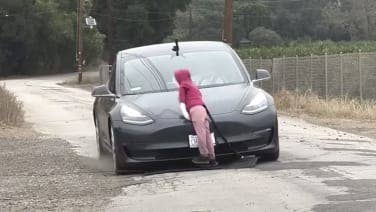
Tesla spends less on advertising than almost every other automaker, but the company got some significant and perhaps unwanted free publicity during last night’s Super Bowl broadcast. The Dawn Project, founded by tech mogul Dan O’Dowd, aired a commercial in some markets criticizing Tesla’s driver assistance features, asking, “Why does NHTSA allow Full Self-Driving?”
“Full Self-Driving” (FSD) is the autonomous driving system that Tesla has been controversially using customers to beta-test on public roads. The ad displays a laundry list of FSD failures, including passing a stopped school bus, ignoring “do not enter” signs, and hitting mannequin babies in strollers. The automaker’s fans have not done much to inspire confidence in the software, either, posting dozens of videos showing it traveling down one-way streets, veering into oncoming traffic, and other serious missteps. Tesla warns on its website that the features do not make the vehicle fully autonomous, but drivers have been involved in several accidents while using the technologies.
Though the Super Bowl commercial is its highest-profile action to date, The Dawn Project has been around since early 2022. It has released other videos of Tesla vehicles mowing down mannequins, which it took during dozens of its self-conducted tests. The films are dramatic and help illustrate The Dawn Project’s points, but it’s important to note that the tests were not official and do not conform to the test processes followed by the National Highway Traffic Safety Administration (NHTSA) or the Insurance Institute for Highway Safety (IIHS).
Another big caveat is that O’Dowd is CEO of Green Hills Software, which develops self-driving software and supplies Mobileye, which until 2016 was a Tesla supplier. So he has expertise in the area of autonomy, but could also be regarded as a Tesla competitor. Tesla leans on several companies for the chips and hardware it needs for FSD, including Apple chipmaker TSMC.
FSD supposedly works on city streets and highways and offers hands-free driving in some situations. Tesla says FSD enables its vehicles to automatically change lanes, enter and exit highways, recognize stop signs, and more. It’s an add-on feature to the company’s Autopilot software and costs $15,000 in total, or $199 for a monthly subscription. The National Highway Traffic Safety Administration has opened investigations into the way Tesla allows drivers to initiate and use FSD after several crashes made news, including an eight-car pileup on the San Francisco Bay Bridge.
The Dawn Project’s ad said Tesla was “endangering the public with deceptive marketing and woefully inept engineering.” On its website, The Dawn Project says Tesla’s FSD software is “not safe for public roads” and “will commit a concerning array of critical driving errors.”
O’Dowd tweeted Saturday saying The Dawn Project had six months ago reported that a Tesla with FSD enabled “would run down a child.” O’Dowd said the National Highway Traffic Safety Administration (NHTSA) should “turn off FSD until Tesla fixes all safety defects.”
The NHTSA launched a program to test fully-autonomous vehicles in 2020. Tesla has been able to avoid reporting collision data as it maintains that its cars aren’t currently classified as fully autonomous, because they still require human intervention.
Tesla CEO Elon Musk, who was pictured sitting next to Rupert Murdoch at the Super Bowl, said in a tweet Sunday that The Dawn Project’s ad would “greatly increase public awareness that a Tesla can drive itself (supervised for now).”
Includes material from Insider.
About the author

Chris Teague
News Editor, Autoblog