
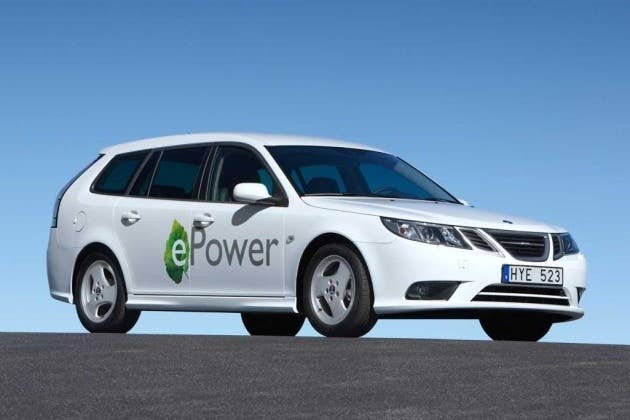
Saab ePower EV Prototype – Click above for high-res image gallery
When Saabunveiled its first-ever electric vehicle (EV), the 9-3 ePower, we ecstatically claimed:
With a projected range of 125 miles and a 0-60 mile per hour acceleration time of less than 8.5 seconds, Saab‘s first-ever electric vehicle, the 9-3 ePower, brings the automaker into the battery-powered mix with authority. Based on the 9-3 Sport Combi wagon, the Saab 9-3 ePower’s cargo-hauling abilities offer versatility that’s typically absent in the battery-powered segment.
Unfortunately, we had to close that article with the words of Saab chief executive officer, Jan Ake Jonsson, who was prodded about a target release date for Saab’s first EV and responded with:
Everybody is looking at that question. Nobody has an answer. It will take some time.
Now, some new info suggests that the ePower could be production-ready sooner than first thought. That is, provided that Saab gives it the green light. Boston-Power, supplier of the ePower’s battery pack, revealed that its Swing 4400 cells provides the punch for Saab’s EV. The Swing cells are not Saab-specific and are already available at a mass-production level.
The Swing cell utilizes cobalt and manganese on the cathode with graphite on the anode and is based on an oval-shaped prismatic cell design. The external dimensions are nearly equivalent to two 18650 lithium-ion cells, but testing has proven that the Swing 4400 cells are quite robust and Boston-Power claims that the cell specs include:
- Energy density of 180Wh/kg
- Volumetric density of 420Wh/L
- 1,000+ cycles at 100% Depth Of Discharge (DOD)
- 2,000+ cycles at 90% DOD
- Constant power of 440W/kg
- Pulse power of 1,500 W/kg (2s pulse)
If Saab gives the nod to the 9-3 ePower, then Boston-Power will be ready to deliver. So, let’s hope that showgoers in Paris drool over the model and urge the automaker to give it a go.
Featured Gallery


[Source: Green Car Congress]