
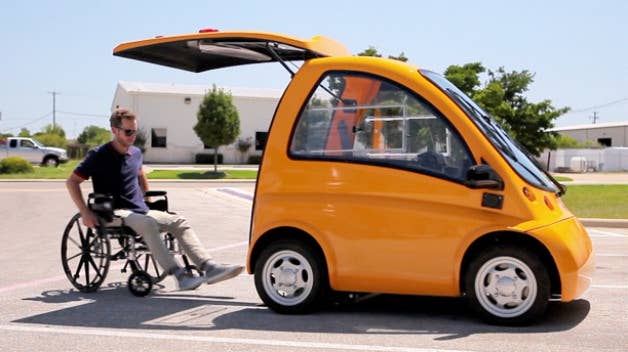
The people behind the subway-friendly, all-electric Kenguru have experienced many of the ups and downs that other start-up EV companies are all too familiar with. In fact, when you first go to the Kenguru website, it doesn’t ask if you want to buy a car, it says “Investors Wanted!”
But that drama hides a simple idea that is executed so well here. The Kenguru is basically a battery-powered, car-shaped wrapper for a wheelchair. That idea, to help people with mobility difficulties achieve a new level of independence, is elucidated nicely by Stacy Zoern, CEO of Community Cars (the company now behind the Kenguru; the vehicle was originally designed by Rehab, Ltd in Hungary) in a new video by our friends at Translogic. Watch it below.
Based in Pflugerville, TX, Community Cars assembles the Kenguru by hand, but it currently doesn’t have enough money to make and sell them (see: call for investors). The latest hiccup isn’t stopping Zoern, who says that a joystick-driven model is coming next. This will be a big deal for her, because, as you can see in the video when she shakes hands, she does not have the upper-body strength to drive the current version. She has driven a car before, a converted “normal” car that cost $80,000, but ended up getting into an accident, making the cheaper Kenguru – at $25,000 – both personal and practical. We think that the Kenguru is also a perfect candidate for wireless charging.
The RWD, fiberglass Kenguru has but one door – in the back to allow a wheelchair to roll on in – and has a top speed of 45 kilometers an hour (28 miles per hour) and a range of somewhere between 70 and 110 km (43-68 miles). It also qualifies, in some areas, for both green vehicle credits as well as vocational rehabilitation incentives. That just might make it the best kind of hybrid.
Show full PR text
Technical Specifications
Engine
2 gearless synchronous belt driven wheel drives on the back axle
Performance: 2Kw/150 Nm per Motor
Operating Voltage: 48V AC
Brushless internal Rotor
Running Gear
Independent double wishbone wheel suspensing in the front
Hauled single sided swingarms in the back
Shock absorber with adjustable preload
4 hydraulic disc brakes
Locking brake operating on the front wheels
Rimsize: 12*2, 2
Wheelsize: 100/ 90-12
Chassis
Fiberglass chassis on steel frame
Doors: 1
Seats: Room for one driver with wheelchair
Dimensions and Weight
Wheelbase: 1550 mm
Length: 2125 mm
Width: 1620 mm
Height: 1525 mm
Empty weight without driver: 550Kg
Empty weight without driver and batteries: 350Kg
Allowed total weight: 660 Kg
Driving Performance
Maximum Speed: 45 Km/h
Climbing Ability: 20%
Range: 70- 110 km
Operation
Steering via Motorcycle handlebar (via Joystick from 2012)
LED display on dashboard
Electrical door opening system controlled via remote control