
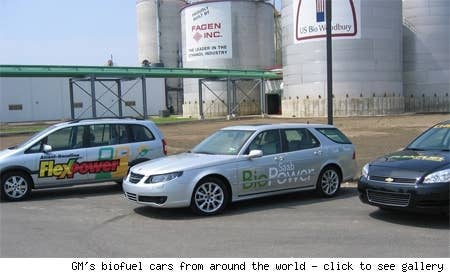
At the GM/US BioEnergy media event a while ago, GM had, appropriately enough, some of their flex-fuel vehicles from around the world on display. Not to drive, but to peek at. The one that stood out to me was the Zafira, usually sold with the Opel badge, but this particular minivan had the Chevy symbol and lots of Flexpower branding on the sides. GM is doing some tests with the Zafira here in Michigan, but nothing special.
What I wanted to share with you was one little bit of information about how GM’s flex-fuel systems work in Brazil. It’s a system that would not be possible in the US, thanks to differences in emission and safety laws, but it’s both clever and annoying in the world’s Number One ethanol-using country.
The problem with E100 is that you can’t start a car with it in the cold, anything below 40-42 degrees Fahrenheit because there isn’t enough vapor pressure. So, to start the E100 cars when it’s chilly out, the Zafira and other Brazilian flex-fuel models have a six ounce reservoir that holds standard gasoline/petrol that is used to fire up the engine when necessary. This is also where the annoying part come in: GM’s number one customer complaint in Brazil comes because people forget to fill this tiny gas tank up and can’t start the car. In the photo gallery below, the reservoir is the thing with the red cap.
This little fact about E100 explains why E85 was developed in the first place. With E85, you don’t need the dual-fuel system and can start the car in a wider range of temperatures. And now you know.
Featured Gallery

MSRP: $21,100 – $23,370
Invoice: $19,834 – $21,447
Fuel Economy: 45 mpg Hwy/48 mpg City
The Toyota Prius sets the standard for environmentally friendly hybrid transportation. It delivers extremely good fuel efficiency in a front-wheel drive, five-door liftback.
- Research the Toyota Prius
- Full Overview
- Compare This Car
- Get a Free Price Quote

MSRP: $22,140 – $22,140
Invoice: $20,812 – $20,812
Fuel Economy: 32 mpg Hwy/24 mpg City
The Saturn Aura Green Line is an environmental friendly hybrid family sedan. Its electric motor assists the combustion engine during acceleration and allows the combustion engine to shut off at a stand still to save gas.
- Research the Saturn Aura Green Line Hybrid
- Full Overview
- Compare This Car
- Get a Free Price Quote

MSRP: $22,140 – $22,140
Invoice: $21,033 – $21,033
Fuel Economy: 32 mpg Hwy/24 mpg City
The highly anticipated 2008 Chevy Malibu Hybrid will make it’s debut utilizing GM’s “mild hybrid system” rather than its dual mode full hybrid system.
- Research the Chevrolet Malibu Hybrid
- Full Overview
- Compare This Car
- Get a Free Price Quote

MSRP: $22,600 – $22,600
Invoice: $20,789 – $20,789
Fuel Economy: 45 mpg Hwy/40 mpg City
The Honda Civic Hybrid is one of the most popular compact hybrid sedans in its class. It is based off the regular Civic that has been a best seller in the compact car market for years.
- Research the Honda Civic Hybrid
- Full Overview
- Compare This Car
- Get a Free Price Quote

MSRP: $24,170 – $24,170
Invoice: $22,720 – $22,720
Fuel Economy: 32 mpg Hwy/25 mpg City
The Saturn VUE Green Line is a compact sport utility vehicle that gets more European design styling this year. It incorporates hybrid technology into the Vue lineup.
- Research the Saturn VUE Green Line Hybrid
- Full Overview
- Compare This Car
- Get a Free Price Quote

MSRP: $25,170 – $25,170
Invoice: $23,591 – $23,591
Fuel Economy: 33 mpg Hwy/35 mpg City
The Nissan Altima Hybrid offers performance, comfort, safety, economy, and good looks in this environmentally friendly family sedan.
- Research the Nissan Altima Hybrid
- Full Overview
- Compare This Car
- Get a Free Price Quote

MSRP: $25,310 – $29,570
Invoice: $23,680 – $27,653
Fuel Economy: 30 mpg Hwy/34 mpg City
The new for 2008 Mazda Tribute Hybrid Electric Vehicle (HEV) is Mazda’s latest addition to their line-up. Providing the same size and convenience as the regular Tribute, but with the added environmental benefits of a hybrid powertrain.
- Research the Mazda Tribute Hybrid
- Full Overview
- Compare This Car
- Get a Free Price Quote

MSRP: $25,350 – $25,350
Invoice: $22,814 – $22,814
Fuel Economy: 34 mpg Hwy/33 mpg City
The Toyota Camry Hybrid sedan brings the quality and reliability of the Camry together with increased fuel efficiency.
- Research the Toyota Camry Hybrid
- Full Overview
- Compare This Car
- Get a Free Price Quote