
In one California town, police have arrested a man who allegedy stole more than 1,100 gallons of gas from a nearby Shell station. In another city, several gas stations posted cardboard signs by their idle pumps. “Closed.”
Similar portraits of desperation emerged across the state Monday as Californians grappled with sky-high gas prices, gas shortages and rations.
California Gov. Jerry Brown directed state agencies to speed their switch to a more-available winter blend of gas that wasn’t due to take place until Oct. 31. Meanwhile, U.S. Senator Dianne Feinstein asked the Federal Trade Commission to investigate the spike in prices, which reached an average of $4.66 per gallon of regular, the highest in the country.
One gas station in Long Beach, Calif., advertised regular for $6.65 per gallon, according to GasBuddy.com, the priciest in the state. One GasBuddy.com analyst predicted average prices could rise as high as $4.85 per gallon in California before peaking.
So far, the problems that caused California’s spike are isolated in the Golden State, where prices have increased 55 cents per gallon since averaging $4.11 on Sept. 28. By comparison, the national average has increased from $3.79 to $3.80 in the same span.
But the prices seen in California could spread nationally in the next couple of years through a few scenarios. When economies heat up an demand for gasoline goes up, so do prices. Oil prices have been hovering around $100 a barrel even though the U.S. economy is sluggish and Europe’s is in the tank. Analysts warn that when the U.S. and Europe are recovering together at a higher rate of growth, combined with rising demand in China, oil and gasoline prices will climb in tandem.
Perfect Storm
In California, experts blame a collision of several factors for California’s gas-price spike. ExxonMobil and Tesoro had shut down refineries for scheduled maintenance and Chevron had shut one down due to an August fire. A pipeline feeding the San Francisco market was also shut down because of suspected contamination.
“We’re obviously extremely disheartened that we are unable to do this, and we’re pulling fuel from all corners of California to fix this,” Jeff Cole, Costco’s vice president of gasoline told Bloomberg Businessweek, about the chain’s shuttered pumps. This, “feels like a hurricane to me, but it’s the West Coast.”
The fact gas prices and energy policy in general have been hot-button political issues this election season has only sharpened the scrutiny on the behind-the-pump forces at play in California.
In a letter of chairman Jon Leibowitz, Feinstein wrote the FTC has “failed to take action to protect California consumers from malicious trading schemes in the California gasoline market.”
Featured Gallery

Pickups aren’t supposed to get 18 mpg in the city and 25 mpg on the highway.
They’re too big, too powerful and traditionally have had the aerodynamics of a pole barn.
Just a few years ago, midsize sedans barely reached the mid 20s in highway driving. A 2009 Ford Fusion with all-wheel drive and a 3-liter V6 gets an estimated 17 mpg in the city and 25 mpg on the highway, giving it a lower combined mileage than the 2013 Ram 1500.
We have come a long way baby. Carmakers like Chrysler Group LLC have incorporated some new and old technologies to improve a vehicle’s mileage. The real improvements stem from the total of technologies used and a eye for detail to include as many as possible.
Click through to see some tricks that Ram uses, as many more vehicles are likely to begin incorporating them too.
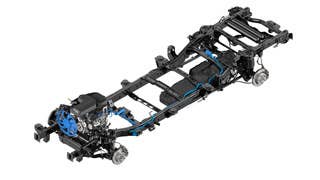
Where it comes from? Every carmaker is looking for ways to cut weight from its vehicles. Like the pounds we all carry around, weight loss is an obsession.
How it works: Carmakers have moved to higher strength steel to cut weight and add strength. The Ram goes a step further by redesigning its frame to shed 30 more pounds. Additionally, former steel exterior panels are beginning to be replaced with other materials. By the Ram replacing its steel hood with an aluminum one, it saved 26 pounds.

Where do they come from? We first saw these appear on hybrids and slowly they are making their way onto other vehicles. The Ram is the first pickup to use them.
How they work: The shutters work like Venetian blinds. They remain open to let more air move across the radiator to help cool the engine. But when the engine is running at its optimal temperature, the shutters close to push the air around the vehicle, thus lowering air resistance and improving fuel economy.

Where does it come from? Managing an engine’s temperature has been around as long as engines have been powering vehicles. But now, carmakers have begun to fine-tune an engine’s temperature knowing that the longer an engine can maintain the same heat, the less energy it wastes.
How it works: Ram engineers have found a number of ways to reduce load on the engine and keep its temperature at the optimum level. Much like the active grille shutters, engineers use an alternator that only charges the battery when needed. Additionally, a cooling fan on the engine operates only when needed. Furthermore, every piece inside the engine is designed to have as little friction as possible, also making it more efficient. And while too hot is not good for an engine, neither is too cold. That’s why the Ram 1500 quickly raises the temperature of the engine to help things like the transmission fluid run at its most optimal temperature.

Where they come from? Tires have always played an important roll in a vehicle’s performance. And while many people have focused on tire pressure to improve fuel economy, carmakers have begun including low-rolling-resistance tires as another way to increase a vehicle’s mileage.
How they work: These wheels are basically stiffer than regular tires. This means the sidewalls don’t resist as much and the tires spin easier. There is less resistance, when rolling. The downside to harder tires, however, is that performance can be compromised. The key is to find a happy medium between performance and efficiency. All Ram 1500 pickups come standard with low-rolling-resistance tires.
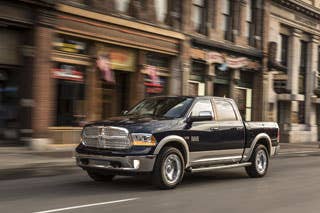
Where does it come from? The stop/start system first gained popularity with gas-electric hybrids. To help the gas engine’s efficiency, developers created a stop/start system to turn off the engine and run the car’s other systems via the large battery pack onboard. Now, non hybrids have begun to use version of this system to help improve city mileage. Ram engineers estimate a 3.3 percent increase in fuel efficiency.
How it works: When you stop the truck, like at a stop-light, or even to make a left turn in a turing lane, the engine goes off. Don’t worry. It’s just sleeping. Touch the gas-pedal and the power and the engine snaps back into action and the power is there for you. The re-start is hardly noticeable.
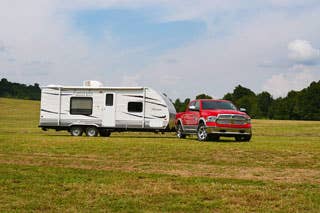
Where it comes from? The love affair with air suspension dates back nearly 100 years, but is rarely used today. High end luxury vehicles do use some air suspension system to soften the ride of their big heavy vehicles. The Ram 1500 incorporates the system taken from the Jeep Grand Cherokee. The rear coil spring construction – other pickups use leaf springs – makes adding this suspension system relatively easy and allows the Ram to adjust its height by four inches.
How it works: Air suspension can lift or lower a vehicle easily. In the case of the Ram, it raises the truck to give it additional clearance, as well as adjusting the front and rear ends depending on how its loaded, to create a more balanced ride. To gain fuel economy, the air suspension lowers the Ram to create better aerodynamics. This type of active adjustment of a vehicle while its in motion is going to become more common in future vehicles.