
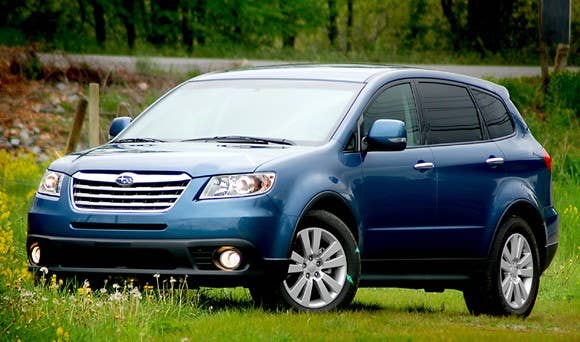
“It looks like a puppy,” my wife said upon first setting eyes on the 2008 Subaru Tribeca. That’s an apt description of any Subaru; they usually feel quite eager from behind the wheel, and they’re trusty companions. The new front end on the Tribeca is more bland than the outgoing aviation-inspired look, but that hasn’t dulled the inherent goodness of this big CUV.
The power unit has also seen upgrades. B9-era Tribecas (the alphanumeric has been dropped for ’08) had 3.0 liters of horizontally opposed 6 cylinder to haul 4300 pounds. Power delivery was on the revvy side, so maximum torque didn’t arrive until you wound it up a bit. 2008 brings more than a half-liter capacity bump, making the Tribeca feel more sprightly with not only more grunt, but also revised delivery characteristics that better suit most drivers.
Featured Gallery

While the focus of the show is obviously the ever-growing green movement, hybrid and electric vehicle debuts were only part of the excitement. While most of the following list will eventually be sold in the U.S., there are a few entries that are still a question mark. Perhaps we could persuade some of the automakers if we try hard enough.
The 80th Geneva Motor Show opened its doors to the press today and we were treated to dozens of interesting cars being shown for the first time. Besides the always entertaining and fantastic concept cars, there were several significant production car debuts in Geneva. We have assembled a gallery featuring the best from the first day of press conferences.
Autoblog
The Mini Countryman will be the third model in the Mini range when it reaches showrooms in 2011. It will also be the brand’s first crossover, with an optional ALL4 all-wheel drive system giving good traction in any conditions. The Countryman is the largest vehicle in Mini’s lineup too, with enough space inside for four adults plus their gear. Engines will most likely include the same 1.6-liter four-cylinder units available in the current Mini range.
Drew Phillips / Copyright ©2010 Weblogs, Inc.
The 2011 Volkswagen Touareg is an all-new design that has dropped some of its expensive and heavy off-roading equipment in favor of better on-road performance and improved fuel economy. For serious off-roaders, the new Touareg can still be ordered with an optional Terrain Tech Pack. VW has sold 500,000 of the previous-generation Touareg SUVs to date, so the updated styling and mechanical changes should help it stay just as popular.
Autoblog
Just like the new Volkswagen Touareg, the 2011 Porsche Cayenne is all-new, with more modern styling and new mechanicals. There will be a new Hybrid model coming to the 2011 Cayenne line as well, a first for the legendary German sportscar maker. The hybrid should give buyers 23-percent better fuel economy according to Porsche. Part of that gain will come from “sailing,” which is when the drivetrain is disengaged from the engine, reducing drivetrain losses.
Autoblog
The Nissan Juke is an all-new crossover that will join the larger Murano and Rogue in the Nissan lineup. Nissan is hoping the oddly styled Juke will be a hit when it reaches North America for 2011. For Europe, the Juke is available with a 1.5-liter diesel that probably won’t make it to this market, as well as a pair of 1.6-liter gasoline engines (that likely will). The compact CUV will be made in both front- and all-wheel drive configurations.
Chris Paukert / Copyright ©2010 Weblogs, Inc.
The Lexus CT 200h is the company’s new entry-level luxury hybrid hatchback. Similar to the well-known Toyota Prius it is powered by both a gas engine and an electric motor that come online as needed. Toyota’s proprietary Hybrid Synergy Drive technology makes the decisions on which power source is needed given the driving conditions. According to Lexus, the CT 200h can run in EV mode for up to 1.2 miles at speeds up to 28 miles per hour.
Autoblog
The Mazda5 is one of those vehicles that seems to do just about everything right, but doesn’t get a lot of attention. For 2011, the Japanese automaker has added a bold new design to the exterior that should change that. Mazda’s new “Nagare” design theme has now been applied to nearly every model in the lineup, with the new 5 getting the same smiling front end as the 2010 Mazda3. The Mazda5 microvan goes a step further however, with a trio of dramatic, wave-like character lines running down the side. The 2011 Mazda5 will also receive an upgraded interior and will offer the bigger 2.5-liter engine found in the Mazda3.
Drew Phillips / Copyright ©2010 Weblogs, Inc.
One of the hottest cars at the 2010 Geneva Motor show is undoubtedly the 2011 Lamborghini Gallardo 570-4 Superleggera. The new “superlight” edition of the Italian sportscar is 70 kilograms lighter than the standard model, or 154 pounds. It is propelled by a direct-injected 5.2-liter V10 that develops 570 horsepower. Lamborghini claims it can do 0-62 mile per hour in just 3.4 seconds and has a top speed of 202 mph.
Drew Phillips / Copyright ©2010 Weblogs, Inc.
Although Audi hasn’t said that it will be bringing the new RS5 to America, we couldn’t resist telling you about it. The RS5 is the highest performance version of the company’s shapely A5 coupe, with a 450-horsepower 4.2-liter V8, Audi’s legendary Quattro all-wheel-drive system, a revised suspension and a 77,000 Euro price tag. The company has had a policy of selling only one RS model at a time in the U.S. And with the RS4 model being phased out, we might just have a chance of getting it over here.
Drew Phillips / Copyright ©2010 Weblogs, Inc.
The 2011 Porsche 911 Turbo S revives the “S” badge that hasn’t been used on a Turbo 911 since the last generation car. It starts as a regular 911 Turbo and adds just about every performance option you could get from Porsche. It also boosts horsepower to 530, giving this version enough oomph to push it from 0-62 in just 3.3 seconds and to give it a top speed of 196 mph.
Autoblog
The Audi A1 is the company’s smallest offering and the least likely to be sold in the United States. Similar in size to a Mini Cooper, it would be quite a bit smaller than the current smallest Audi, the A3. Available in Europe with a range of turbocharged engines it should be good for up to 44 miles per gallon in the U.S. Ratings. Audi is even showing an concept hybrid version of the A1 as part of the new e-tron family of green vehicles.
Drew Phillips / Copyright ©2010 Weblogs, Inc.
Not since 2007 has Ford offered a wagon version of their compact Focus model in America. When the Focus received an update in 2008, Ford decided that Americans didn’t want the utilitarian wagon so it was dropped from the lineup. In Geneva this week, the company showed their 2012 Ford Focus Wagon, based on the same platform as the recently shown sedan and hatchback. Handsome and versatile, the wagon may return to the U.S. Focus range if there is enough demand.
Drew Phillips / Copyright ©2010 Weblogs, Inc.
The four-wheel-drive ASX will show up in America later this year as the Outlander Sport, powered by a 2.0-liter gasoline four-cylinder borrowed from the Lancer. That combination should return about 30 miles per gallon. The ASX also signals a new focus for Mitsubishi, taking the automaker away from its conventional SUVs to being “a manufacturer of non-mainstream environmentally friendly passenger cars & crossovers, retaining a presence in the ‘authentic off-roader’ sector.”
Drew Phillips / Copyright ©2010 Weblogs, Inc.
The all-new 2011 Kia Sportage debuts with the marketing tag, “Longer, lower, wider, more spacious.” The five-seat crossover will be available in front- or all-wheel-drive forms, with your choice of a manual or automatic transmission. Global engine choices include two gas and two diesel engines, but Americans will probably only see the 163-horsepower gasoline four-cylinder. It is a handsome makeover and should make the Sportage a worthy contender in the compact SUV class.
Drew Phillips / Copyright ©2010 Weblogs, Inc.
As Volvo gets a new owner, changing hands from Ford to Chinese automaker Geely this year, the success of this new 2011 S60 sedan is crucial to the company’s ongoing existence. Previewed in concept form at the Detroit Auto Show, the production version of the new Volvo S60 made its debut in Geneva. As a carmaker known for safety, the new S60 debuts the company’s new Collision Warning system that will, if necessary, fully engage the brakes. The S60 that was shown in Geneva is the T6 model, powered by a turbocharged 3.0-liter inline six with 300 horsepower and 325 lb-ft of torque. Other engine options will be offered worldwide.
Noah Joseph / Copyright ©2010 Weblogs, Inc.
Volkswagen doesn’t sell the Polo model in the United States…yet. The German automaker has said there is a possibility that it will in the future. For now, we can only discuss the merits of this terrific subcompact, shown in Geneva in sporty GTI form for the first time. The Polo GTI is powered by a 178-horsepower turbocharged and supercharged 1.4-liter four-cylinder engine. VW will begin producing the Polo in North America soon, so we might just get this little hatch in the U.S. yet.
Drew Phillips / Copyright ©2010 Weblogs, Inc.
The Lotus Evora 414E Hybrid is a concept that could see production in two-to-three years. Unlike the Toyota Prius which can run on its gas engine or its electric motor independently, the Evora 414E runs on batteries (for up to 35 miles) before a 47-hp three-cylinder engine turns on to recharge those batteries. There are actually two electric motors in the 414E, producing 408 horsepower and 590 pound-feet of torque. One cool feature that will aid pedestrian safety is the new Lotus HALOsonic Internal and External Electronic Sound Synthesis system to help the nearly silent Evora sound like a “real” car.
Drew Phillips / Copyright ©2010 Weblogs, Inc.
Just a concept for now, the Audi A8 Hybrid is powered by a 211-horsepower 2.0-liter gasoline engine boosted by a 45-hp electric motor. It offers acceleration comparable to a regular sedan, yet the gas mileage is much better at 38 miles per gallon.
Autoblog
You know that hybrid technology has really caught on when even a legendary sportscar maker like Ferrari is using it. The Ferrari 599 HY-KERS is not a typical hybrid, though. The HY-KERS is a pretty normal Ferrari 599, but it also incorporates a version of Ferrari’s Kinetic Energy Recovery System – a.k.a. regenerative braking – developed in last year’s Formula One program.
Noah Joseph / Copyright ©2010 Weblogs, Inc.
Built on the all-new 2011 BMW 5 Series, the ActiveHybrid model uses a turbocharged six-cylinder engine along with a 53-horsepower electric motor working through an eight-speed automatic transmission. BMW claims that the system returns 10-percent better fuel economy, plus an extra helping of instant boost during acceleration.
Autoblog
Tata Motors bills its Nano as the cheapest car in the world. Although not for sale in the United States just yet, a version of the Nano will go on sale in Europe later this year. At the Geneva Motor Show the company showed an electric version of that Nano. The Tata Nano Electric Vehicle (EV) will be built on the existing Nano platform, will seat four adults, and promises a range of 160 kilometers (99 miles) and acceleration of 0-60 kilometers per hour in under 10 seconds.
Chris Paukert / Copyright ©2010 Weblogs, Inc.
The Porsche 918 Spyder Concept is about the size of the German automaker’s Boxster, but it looks more like an updated version of their late Carrera GT supercar. Underneath that sexy bodywork resides a 500-horsepower V8 plus two axle-mounted electric motors adding an additional 218 horsepower. With all of that power it’s not surprising that the 0 to 60 time is claimed to be just 3.2 seconds.
Drew Phillips / Copyright ©2010 Weblogs, Inc.
Mercedes-Benz seems to be one of the few automakers that still understands the value of theater at auto shows. While unveiling their F800 Style concept, the German automaker had dancers dropping from the ceiling, lights blaring, and Formula 1 drivers Nico Rosberg and Michael Schumacher gracing the crowd with their presence. The F800 Style concept is said to preview the shape of the company’s next CLS, and is a plug-in hybrid with a gasoline V6 engine working with an electric motor to produce over 400 horsepower.
Chris Paukert / Copyright ©2010 Weblogs, Inc.
Honda may be best known for their reliable and amiable cars and trucks, but they also produce everything from ATVs to outboard engines, motorcycles to generators, from personal robots to private jets. That’s why it wasn’t too surprising to see the Japanese industrial giant unveil its odd 3R-C Concept. With two wheels up front and one in the back, the 3R-C is combines motorcycle and car in a uniquely Honda way.
Noah Joseph / Copyright ©2010 Weblogs, Inc.The Tribeca’s styling has had much of its polarizing uniqueness beaten out of it with a bland stick. The most dramatic changes are up front, where the original face’s headlight tunnels and three-piece grille have given way to a far less distinctive frontispiece. In the interest of quieting detractors, the Tribeca has tiptoed to the precipice of anonymity, but thankfully, some of the interesting detailing in the shape pulls it back. Glance quickly, though, and you may mistake it for a DCX minivan. The rump has also come in for a nip and tuck. Gone is the inset on the lower portion of the hatch, the taillamps have been reshaped, and the rear bumper’s facsia has been heavily revised.
Away from the nose and tail, much of the ALFA-esque styling has escaped unscathed. The flanks still carry sculpting that catches light and focuses your gaze. The rear quarter windows have been enlarged, a boon for visibility, and the D-pillar comes away successfully tamed. Even with its funkectomy, we still find the Tribeca interesting to look at, and the vehicle continues to stand apart in a crowded field.
Inside and out, the Tribeca is unabashed about the dashing line it cuts. The sides are hewn in a way that catches light and dribbles reflections like liquid. The more you gaze at the Tribeca, the more you like it, even with the higher nose and more traditional (and large) grille. Inside, the swoopy dash and fresh design still remains. The materials are well done, if more workaday than luxo-plush. Silver plastic trim always raises questions about longevity, but what we saw in the belly of the beast appeared like it’d ward off scuffs and nastiness.
Instrumentation is clean and easily read, with electroluminescent gauge faces. We were less than impressed by the “information center” LCD screen at the top of the center stack; what’s so wrong about keeping feedback local to the controls? The speedo and tach sit at the bottom of two nacelles and the temperature and fuel gauges flank the circular tunnels. The treatment adds a bit of levity to the often-blah territory of vital information delivery. The dance that the gauge needles do when you first energize the electrical system is a novel trick, too. Our test car was not equipped with navigation, which would have placed a touch screen where the underwhelming LCD took residence. The display has a tendency to half-disappear when wearing polarized sunglasses, which made it difficult to read quickly, though we’re sure part of the reasoning for the LCD in the first place is that it’s a central repository for information about what the HVAC and radio are doing. We found ourselves looking at a knob that was bankrupt of any indication of setting, rather than going first to the LCD for information. Looking somewhere other than the control you want to adjust is just unnatural. It’s kind of like driving the car via a VT100 terminal, and it’s maddening. The HVAC’s trio of rocker action knobs take practice, and the digital readouts in the center of the temperature selection knobs look cooler than they are in practice. Since the knobs have a rocker action, there’s no way to quickly discern what they’re set to without taking your eyes off the road long enough to comprehend the number in the readout. The central fan speed knob would also be better with detents, rather than returning to center. The other ventilation controls hide out just in front of the shifter, and can be difficult to quickly locate since the buttons are all alike, with low contrast markings.
The rest of the controls are easy to figure out, and fall easily at hand. The driving position and provisions are comfortable in that familiar, friendly Subaru way. The seats had tasteful, grippy fabric, and were quickly adjusted to proper posture. There are three rows of seats available in the Tribeca, but we think that the space is better utilized as cargo area, like our two row tester. The 2nd row is also more accommodating without a third row nipping at its heels. Even though the Tribeca carries high style, with its front quarter windows, deeper front airdam and powerful wheel arches, the D-pillars don’t bite into useful interior space like in other vehicles such as the Infiniti FX. The load area with just two rows accommodates a long day of consumerism at the temple of the buck without a whimper.
When you finally break free from the joy of beating down your credit score, the drive home is a refreshing respite from the humdrum conveyances that surround you on your suburb to suburb trek. The steering operates with well-oiled precision and is weighted nicely for locking on to straight ahead. The Tribeca is definitely a Subaru from the driver’s seat. Wheel motion is well controlled and the Tribeca doesn’t have an aversion to rounding corners.
Subaru continues with its uncommon powertrains to good result with the newly-enlarged H6. The 3.0 didn’t have enough room in the case for a traditional bore and stroke job to offer the desired size increase, so a slightly triangular connecting rod was developed to facilitate more stroked volume without an increase in deck height. It sounds like a lot of effort to go through when they could have just made the engine a little wider, but by maintaining the same external dimensions, re-cyphering the engine bay wasn’t necessary, keeping costs down. There are lots of other detail changes to the mill, including variable valve timing on both intake and exhaust cams, and a revised cooling system that drops the octane requirement to 87 R+M/2.
The Tribeca’s idle is very smooth and well isolated, and at speed the 3.6-liter flat six is muted. A stomp on the go pedal is rewarded with a snarl starting around 2,700 rpm, and even with more torque available across the rev range, the 3.6 is better when the tach winds around past three. The engine note is sweetly mechanical, but not as thrilling as what you’d hear from that other company that makes horizontally opposed sixes. That’s an unfair comparison, though, and the Tribeca’s engine sounds good when being caned, and quiets right down when you’re not calling for Full Ahead from the engine room.
The Tribeca’s driving traits put it in good company, running with effete European breeds dynamically. The interior fitment lacks some of the sumptuousness of those vehicles, but that’s not a knock on the big Subie. What you find is a vehicle that carries its size well, offers unique styling and doesn’t have to be apologetic for sloppy reflexes. It’s no Legacy wagon, but that’s exactly the point. The Tribeca exists to fill a hole in the Subaru line not served by the other offerings. It’s a big, family-friendly machine that is thoughtfully packaged, rather than being a V8 stuffed in a ladder frame and topped with an SUV body. The new nose will likely find more play in Peoria, and Subaru’s apparent mission of turning out ersatz half-price BMWs that sacrifice little is carried through the newly freshened Tribeca.
Featured Gallery
While the focus of the show is obviously the ever-growing green movement, hybrid and electric vehicle debuts were only part of the excitement. While most of the following list will eventually be sold in the U.S., there are a few entries that are still a question mark. Perhaps we could persuade some of the automakers if we try hard enough.
The 80th Geneva Motor Show opened its doors to the press today and we were treated to dozens of interesting cars being shown for the first time. Besides the always entertaining and fantastic concept cars, there were several significant production car debuts in Geneva. We have assembled a gallery featuring the best from the first day of press conferences.
AutoblogThe Mini Countryman will be the third model in the Mini range when it reaches showrooms in 2011. It will also be the brand’s first crossover, with an optional ALL4 all-wheel drive system giving good traction in any conditions. The Countryman is the largest vehicle in Mini’s lineup too, with enough space inside for four adults plus their gear. Engines will most likely include the same 1.6-liter four-cylinder units available in the current Mini range.
Drew Phillips / Copyright ©2010 Weblogs, Inc.The 2011 Volkswagen Touareg is an all-new design that has dropped some of its expensive and heavy off-roading equipment in favor of better on-road performance and improved fuel economy. For serious off-roaders, the new Touareg can still be ordered with an optional Terrain Tech Pack. VW has sold 500,000 of the previous-generation Touareg SUVs to date, so the updated styling and mechanical changes should help it stay just as popular.
AutoblogJust like the new Volkswagen Touareg, the 2011 Porsche Cayenne is all-new, with more modern styling and new mechanicals. There will be a new Hybrid model coming to the 2011 Cayenne line as well, a first for the legendary German sportscar maker. The hybrid should give buyers 23-percent better fuel economy according to Porsche. Part of that gain will come from “sailing,” which is when the drivetrain is disengaged from the engine, reducing drivetrain losses.
AutoblogThe Nissan Juke is an all-new crossover that will join the larger Murano and Rogue in the Nissan lineup. Nissan is hoping the oddly styled Juke will be a hit when it reaches North America for 2011. For Europe, the Juke is available with a 1.5-liter diesel that probably won’t make it to this market, as well as a pair of 1.6-liter gasoline engines (that likely will). The compact CUV will be made in both front- and all-wheel drive configurations.
Chris Paukert / Copyright ©2010 Weblogs, Inc.The Lexus CT 200h is the company’s new entry-level luxury hybrid hatchback. Similar to the well-known Toyota Prius it is powered by both a gas engine and an electric motor that come online as needed. Toyota’s proprietary Hybrid Synergy Drive technology makes the decisions on which power source is needed given the driving conditions. According to Lexus, the CT 200h can run in EV mode for up to 1.2 miles at speeds up to 28 miles per hour.
AutoblogThe Mazda5 is one of those vehicles that seems to do just about everything right, but doesn’t get a lot of attention. For 2011, the Japanese automaker has added a bold new design to the exterior that should change that. Mazda’s new “Nagare” design theme has now been applied to nearly every model in the lineup, with the new 5 getting the same smiling front end as the 2010 Mazda3. The Mazda5 microvan goes a step further however, with a trio of dramatic, wave-like character lines running down the side. The 2011 Mazda5 will also receive an upgraded interior and will offer the bigger 2.5-liter engine found in the Mazda3.
Drew Phillips / Copyright ©2010 Weblogs, Inc.One of the hottest cars at the 2010 Geneva Motor show is undoubtedly the 2011 Lamborghini Gallardo 570-4 Superleggera. The new “superlight” edition of the Italian sportscar is 70 kilograms lighter than the standard model, or 154 pounds. It is propelled by a direct-injected 5.2-liter V10 that develops 570 horsepower. Lamborghini claims it can do 0-62 mile per hour in just 3.4 seconds and has a top speed of 202 mph.
Drew Phillips / Copyright ©2010 Weblogs, Inc.Although Audi hasn’t said that it will be bringing the new RS5 to America, we couldn’t resist telling you about it. The RS5 is the highest performance version of the company’s shapely A5 coupe, with a 450-horsepower 4.2-liter V8, Audi’s legendary Quattro all-wheel-drive system, a revised suspension and a 77,000 Euro price tag. The company has had a policy of selling only one RS model at a time in the U.S. And with the RS4 model being phased out, we might just have a chance of getting it over here.
Drew Phillips / Copyright ©2010 Weblogs, Inc.The 2011 Porsche 911 Turbo S revives the “S” badge that hasn’t been used on a Turbo 911 since the last generation car. It starts as a regular 911 Turbo and adds just about every performance option you could get from Porsche. It also boosts horsepower to 530, giving this version enough oomph to push it from 0-62 in just 3.3 seconds and to give it a top speed of 196 mph.
AutoblogThe Audi A1 is the company’s smallest offering and the least likely to be sold in the United States. Similar in size to a Mini Cooper, it would be quite a bit smaller than the current smallest Audi, the A3. Available in Europe with a range of turbocharged engines it should be good for up to 44 miles per gallon in the U.S. Ratings. Audi is even showing an concept hybrid version of the A1 as part of the new e-tron family of green vehicles.
Drew Phillips / Copyright ©2010 Weblogs, Inc.Not since 2007 has Ford offered a wagon version of their compact Focus model in America. When the Focus received an update in 2008, Ford decided that Americans didn’t want the utilitarian wagon so it was dropped from the lineup. In Geneva this week, the company showed their 2012 Ford Focus Wagon, based on the same platform as the recently shown sedan and hatchback. Handsome and versatile, the wagon may return to the U.S. Focus range if there is enough demand.
Drew Phillips / Copyright ©2010 Weblogs, Inc.The four-wheel-drive ASX will show up in America later this year as the Outlander Sport, powered by a 2.0-liter gasoline four-cylinder borrowed from the Lancer. That combination should return about 30 miles per gallon. The ASX also signals a new focus for Mitsubishi, taking the automaker away from its conventional SUVs to being “a manufacturer of non-mainstream environmentally friendly passenger cars & crossovers, retaining a presence in the ‘authentic off-roader’ sector.”
Drew Phillips / Copyright ©2010 Weblogs, Inc.The all-new 2011 Kia Sportage debuts with the marketing tag, “Longer, lower, wider, more spacious.” The five-seat crossover will be available in front- or all-wheel-drive forms, with your choice of a manual or automatic transmission. Global engine choices include two gas and two diesel engines, but Americans will probably only see the 163-horsepower gasoline four-cylinder. It is a handsome makeover and should make the Sportage a worthy contender in the compact SUV class.
Drew Phillips / Copyright ©2010 Weblogs, Inc.As Volvo gets a new owner, changing hands from Ford to Chinese automaker Geely this year, the success of this new 2011 S60 sedan is crucial to the company’s ongoing existence. Previewed in concept form at the Detroit Auto Show, the production version of the new Volvo S60 made its debut in Geneva. As a carmaker known for safety, the new S60 debuts the company’s new Collision Warning system that will, if necessary, fully engage the brakes. The S60 that was shown in Geneva is the T6 model, powered by a turbocharged 3.0-liter inline six with 300 horsepower and 325 lb-ft of torque. Other engine options will be offered worldwide.
Noah Joseph / Copyright ©2010 Weblogs, Inc.Volkswagen doesn’t sell the Polo model in the United States…yet. The German automaker has said there is a possibility that it will in the future. For now, we can only discuss the merits of this terrific subcompact, shown in Geneva in sporty GTI form for the first time. The Polo GTI is powered by a 178-horsepower turbocharged and supercharged 1.4-liter four-cylinder engine. VW will begin producing the Polo in North America soon, so we might just get this little hatch in the U.S. yet.
Drew Phillips / Copyright ©2010 Weblogs, Inc.The Lotus Evora 414E Hybrid is a concept that could see production in two-to-three years. Unlike the Toyota Prius which can run on its gas engine or its electric motor independently, the Evora 414E runs on batteries (for up to 35 miles) before a 47-hp three-cylinder engine turns on to recharge those batteries. There are actually two electric motors in the 414E, producing 408 horsepower and 590 pound-feet of torque. One cool feature that will aid pedestrian safety is the new Lotus HALOsonic Internal and External Electronic Sound Synthesis system to help the nearly silent Evora sound like a “real” car.
Drew Phillips / Copyright ©2010 Weblogs, Inc.Just a concept for now, the Audi A8 Hybrid is powered by a 211-horsepower 2.0-liter gasoline engine boosted by a 45-hp electric motor. It offers acceleration comparable to a regular sedan, yet the gas mileage is much better at 38 miles per gallon.
AutoblogYou know that hybrid technology has really caught on when even a legendary sportscar maker like Ferrari is using it. The Ferrari 599 HY-KERS is not a typical hybrid, though. The HY-KERS is a pretty normal Ferrari 599, but it also incorporates a version of Ferrari’s Kinetic Energy Recovery System – a.k.a. regenerative braking – developed in last year’s Formula One program.
Noah Joseph / Copyright ©2010 Weblogs, Inc.Built on the all-new 2011 BMW 5 Series, the ActiveHybrid model uses a turbocharged six-cylinder engine along with a 53-horsepower electric motor working through an eight-speed automatic transmission. BMW claims that the system returns 10-percent better fuel economy, plus an extra helping of instant boost during acceleration.
AutoblogTata Motors bills its Nano as the cheapest car in the world. Although not for sale in the United States just yet, a version of the Nano will go on sale in Europe later this year. At the Geneva Motor Show the company showed an electric version of that Nano. The Tata Nano Electric Vehicle (EV) will be built on the existing Nano platform, will seat four adults, and promises a range of 160 kilometers (99 miles) and acceleration of 0-60 kilometers per hour in under 10 seconds.
Chris Paukert / Copyright ©2010 Weblogs, Inc.The Porsche 918 Spyder Concept is about the size of the German automaker’s Boxster, but it looks more like an updated version of their late Carrera GT supercar. Underneath that sexy bodywork resides a 500-horsepower V8 plus two axle-mounted electric motors adding an additional 218 horsepower. With all of that power it’s not surprising that the 0 to 60 time is claimed to be just 3.2 seconds.
Drew Phillips / Copyright ©2010 Weblogs, Inc.Mercedes-Benz seems to be one of the few automakers that still understands the value of theater at auto shows. While unveiling their F800 Style concept, the German automaker had dancers dropping from the ceiling, lights blaring, and Formula 1 drivers Nico Rosberg and Michael Schumacher gracing the crowd with their presence. The F800 Style concept is said to preview the shape of the company’s next CLS, and is a plug-in hybrid with a gasoline V6 engine working with an electric motor to produce over 400 horsepower.
Chris Paukert / Copyright ©2010 Weblogs, Inc.Honda may be best known for their reliable and amiable cars and trucks, but they also produce everything from ATVs to outboard engines, motorcycles to generators, from personal robots to private jets. That’s why it wasn’t too surprising to see the Japanese industrial giant unveil its odd 3R-C Concept. With two wheels up front and one in the back, the 3R-C is combines motorcycle and car in a uniquely Honda way.
Noah Joseph / Copyright ©2010 Weblogs, Inc.