

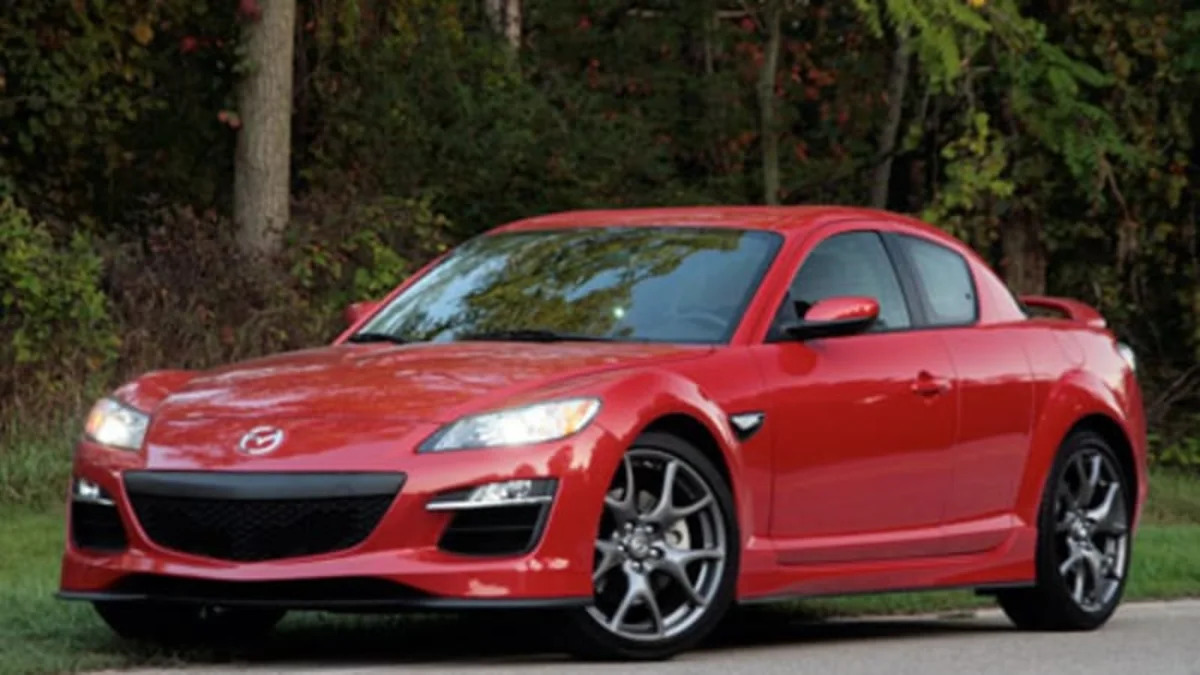
2009 Mazda RX-8 R3 – Click above for high-res image gallery
Hard as it may be to believe, the word "hummer" didn't always bring up visions of obnoxious, polarizing SUVs. In fact, there was a time not so very long ago that uttering that word evoked something entirely different, namely cars powered by Wankel rotary engines. For the past three decades, the world's sole purveyor of rotary-powered automobiles has been Mazda. The "Zoom-Zoom" brand has always been a little different from its compatriots. Back in 1963, a young Kenichi Yamamoto was heading up the research department at Mazda and latched on to the concept developed a decade earlier by Felix Wankel.
Just as two-stroke engines were all the rage for a time in the early 1990s and fuel cells in the middle of this decade, the Wankel rotary seemed to be the next big thing in the 1960s and early '70s. For a time it seemed every major automaker had licensed the design from Wankel and was trying to commercialize it. Some like NSU did build rotaries while General Motors and Daimler Benz built an assortment of concept cars. By the mid-'70s, all had given up except Yamamoto-san and Mazda. From the original 1967 Cosmo, Mazda has built an unbroken string of hummers culminating with the recently updated 2009 RX-8 R3. The pony-keg sized power plant isn't the only unique element of the RX-8, which you can read all about that after the jump.
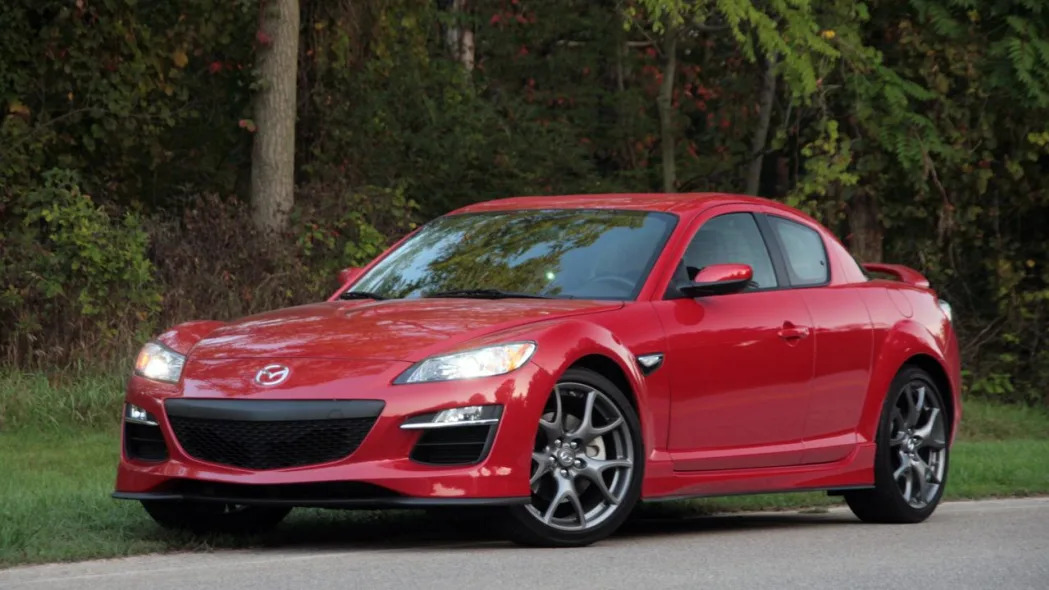
Photos Copyright ©2008 Sam Abuelsamid / Weblogs, Inc.
The car that really made the rotary famous in North America was the RX-7 sports car. Unfortunately, the RX-7 made a premature exit from the U.S. market after the 1995 model year, although it hung around in Japan until 2002. With its two-seat configuration (although rear "jump seats" were offered in Japan for some weird legal reason), the RX-7 was a true sports car. Unfortunately, "sports car" is one of those terms that always seems to cause contention among the zealots in any subject area. The truly hard core will undoubtedly argue that only an open top two seater with SU carbs can be a sports car. We prefer to look at the functionality of a machine and see if the name fits.
When Mazda revamped its rotary design, called it the Renesis and dropped it into the RX-8 body shell with four proper seats and a corresponding number of doors, clearly the traditional definition of a sports car didn't apply any more. If you disregard the secondary half doors that provide access to the rear passenger compartment, the RX-8 certainly has the looks to be a sports car, especially in its newly face-lifted 2009 form. The RX-8 was the first in Mazda's lineup to get the brand's bold-fendered look. Thanks to the diminutive engine package, the RX-8 has a relatively short hood, but its overall proportions still have the cab rearward look one expects of the genre.
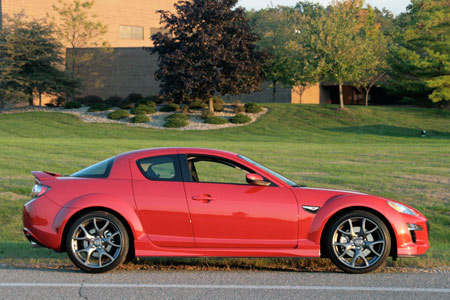
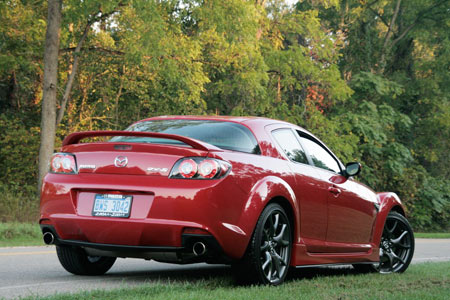
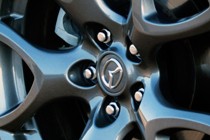
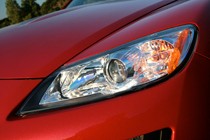
That feeling is further enhanced for 2009 with the new R3 trim level that follows the R1 and R2 models offered back in the RX-7 days. Visually the R3 is distinguished from its siblings by a wing on the rear deck, a slightly more aggressive front splitter and lower fascia as well as rocker panel extensions. The R3 also gets xenon HID headlamps. The best enhancement by far though are the absolutely gorgeous 19 inch forged alloy wheels. Under the skin, the RX-8 R3 also gets a urethane foam filled front cross member to help maintain the relative position of the front wheels and Bilstein dampers.
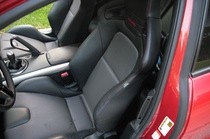
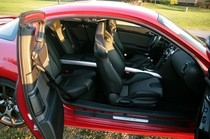
Climb inside the RX-8 and this car certainly feels like a sports car. For those considering whether to opt for an R3 over one of the other trim levels, the biggest deal breaker will be immediately apparent when you sit in the car for the first time. The R3 comes standard with a set of Recaro sport seats. While we would normally never hesitate to recommend Recaros, in this case it all depends on the shape and size of your torso. Unlike most Recaros, the side bolsters on these are not adjustable. The only changes the driver can make are the longitudinal position and seat back angle. If your torso width is in the upper reaches of the population, you will feel quite confined in these seats. If your body fits, then these seats are absolutely fantastic. I just barely fit these seats and they were decidedly snug.
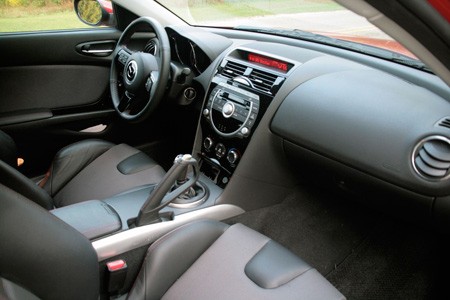
For those relegated to the back seat, accommodations are also tight but better than you'll find in most compact coupes. Leg and head room are passable for anyone up to about six feet tall. Anything more and you'll be hunched over. Mazda wasn't the first to use the rear hinged half doors to ease access to the back, Saturn added them to its coupe in 1999 and they are common trucks as well. Like the others, the latches on the Mazda rear doors are on the front edge meaning you have to open the front doors first.
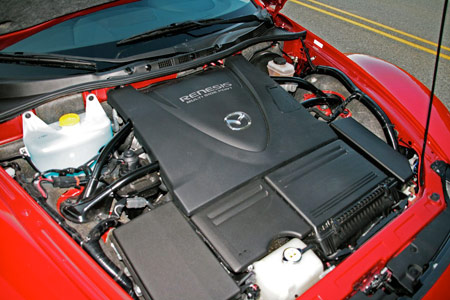
The feature that attracted so many engineers to Wankel's unusual design was the ability to make large amounts of power from a tiny package. In a piston engine, you get one power pulse out of every four strokes or two crankshaft rotations for each cylinder. In a rotary, there are three power pulses per rotation for each rotor. Unfortunately, the reality of actually manufacturing these little wonders proved more difficult than expected. Sealing the rotors was problematic and Wankels typically suffered from both high fuel and oil consumption. Ultimately every automaker except Mazda abandoned the concept. The latest Renesis rotaries seem to have improved the oil consumption issue although they still have a big thirst for gasoline.
The current RX-8 is rated at 16 mpg city and 22 highway. That's not spectacular for a 1.3L engine, but then how many naturally aspirated engines that size crank out 232 hp? The downside of rotaries is a comparatively weak torque curve. The absence of valves and pistons that have to change direction allows this rotary to rev like mad up to a 9,000 rpm redline. Combine that with a slick shifting 6-speed gearbox and you have a recipe for some serious sports car fun.
The RX-8 certainly isn't a drag racer by any means and doesn't have a lot of grunt off the line. But once it's rolling, the presence of those back seats begin to fade away and this is undoubtedly a sports car. With an engine that spins up as fast as a Wankel, plus weak torque characteristics, a lot of shifting is inevitable. Helping to facilitate that is a gearbox with a smooth mechanism and short throws. Making the most of the gearbox requires a proper arrangement of foot pedals and here the RX-8 shines. The pedals are perfectly positioned for fast driving on a tightly wound road. The firm brake pedal is at just the right height to allow easy heel-and-toe down shifts and the clutch pedal take up and travel work beautifully.
The relative absence of torque means you don't feel the punch in the back that you get when you squeeze the go pedal of a Mustang or Corvette. Instead, speed just builds insistently as the engine winds up and you begin to understand why they called these things "hummers". The sound of a Wankel is also like nothing else on the road. Instead of the roar and rumble of a big V8, the pitch of the Wankel just builds in direct proportion to the revs with a precision, mechanical sound.
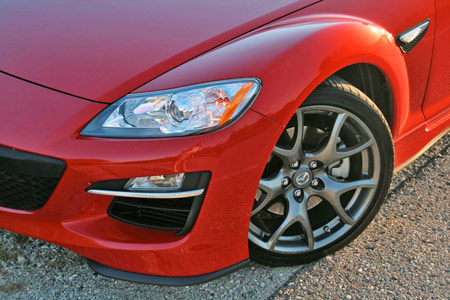
When the time comes to change direction, the RX-8's steering mechanism is definitely up to the task. The effort is a bit on the light side, but there's no slop and adjustments to the wheel angle are perfectly matched by the direction of the car. The double wishbone front and multi-link rear suspension do a wonderful job of keeping the rubber on the road. The car's structure feels solid over uneven pavement and despite the relatively narrow 225/40R19 tires, grip was plentiful. The combination of the suspension, steering and relatively low weight of less than 3,100 lbs. yields a responsive and nimble sports car. The one dynamic issue was the stability/traction control system. When the slip control activates at the limits, it jerks the car back into position too aggressively. Turning the stability control off and repeating the same maneuver, the back end slides away progressively and simply backing off the throttle brings it back in line.
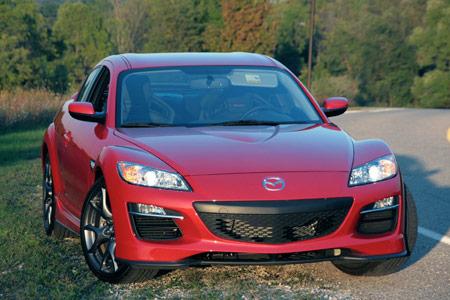
The bottom line is that even with two extra seats compared to the old RX-7, the latest "hummer" from Japan is truly a sports car. The rear seats are just a bonus for those times when you need to bring along a couple of extra friends. Now that the days of the big SUV are coming to an end, it's time for the "Zoom-Zoom" brand to reclaim its nick-name. If only Mazda would offer some adjustable Recaros that allow drivers to fit the car to their bodies, the RX-8 would be almost perfect.
Photos Copyright ©2008 Sam Abuelsamid / Weblogs, Inc.

Sign in to post
Please sign in to leave a comment.
Continue