
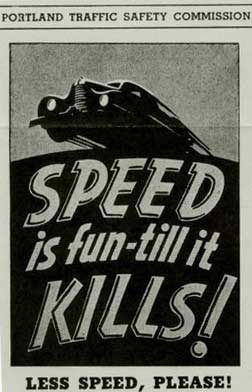
Sometimes numbers lie. But we keep them around because they tell the truth more often than not. The NHTSA undertook a two-and-a-half year study that examined 5,471 injury accidents nationwide in order to figure out how accidents were being caused. Government researchers conducted their own evidence gathering at crash sites in order to establish a first-hand account of causation. What did they find? Among other things, that more drivers crashed as a result of crossing the center line (11%) than as a result of speeding (5%). Speeding, in this case, defined by “too fast for conditions,” not necessarily above the posted limit.
In accidents where driver error was the cause, speeding also came in last as a causative: the 8% who drove too fast were tied with the 8% who fell asleep or had heart attacks while driving. What’s more, the NHTSA’s causation percentages are strikingly similar to the percentages found in an independent study conducted by the Virginia Department of Motor Vehicles. In its study of crashes in 2007, the VDoT found that 2.9% were due to speeding — dead last — while 3.8%t were due to drivers falling asleep or falling ill at the tiller.
What will this mean to the politicians setting and revising speed limits based on the “Speed Kills!” mantra? Probably nothing. But it’s nice to know, and nice to have the government researched numbers to back it up.
[Source: The Newspaper]
Featured Gallery

Power antennas used to be a sign that your automobile had a high-end stereo system. No longer. These days, premium audio systems almost always include optional satellite radio, and you can often spot these systems by the shark-fin antenna somewhere on the car’s roof. Lower-end vehicles still have fixed metal-whip units installed and others have their antennas hidden away in the vehicle’s glass or elsewhere. In any case, it’s rare to see a power antenna in today’s marketplace.

Nearly every car sold today has multiple power points hidden away in its interiors, but one thing seems to be missing on more and more new cars we come across: the cigarette lighter. We’re not entirely sure where the little buggers have gone off to, but a quick scan at the options sheet from a number of our favorite vehicles shows that the classic press-in lighter is part of an optional “Smokers Group,” which generally includes some sort of ashtray to go along with it.

The Compact Cassette as we know it was invented way back in 1964 by Phillips, but they didn’t really become popular as a method of playing recorded music in our automobiles until the 1980s. Even then, the sound quality from cassettes wasn’t all that great. However, its small size and cheap cost that made the cassette a popular option.
Sometime in the early 1990s, the compact disc took over as the format of choice to carry around portable music, and by the late ’90s, it was nearly impossible to find a car that didn’t come equipped with a CD player. Give it a few years and the CD is likely to be replaced by digital music storage units. All good things come to an end.

It hasn’t quite happened yet, but it’s becoming clear that the car key’s days are numbered. Sure, it’s not really all that difficult to insert a small metal key into the ignition and turn it, but pressing a button is just so much better, right? To some, the jury is still out on that point. Regardless, we’d bet your kids will be giving you quizzical looks in about a decade when you tell them stories of misplacing your car keys.

Way back in 1902, at the dawn of the modern car’s birth, Louis Renault invented the drum brake. Later in the 1950s, the self-adjusting drum brake improved the breed by making it more reliable and extending its service intervals, but not much has changed since then — except for the fact that four-wheel discs have pretty much taken over. These days, drum brakes only come on the least expensive new vehicles, and even that’s not likely to last much longer.

If there’s one item on this list that seems like a decided step in the wrong direction, it’s the demise of the full-size spare tire. When you’re pulled over at the side of the road with a puncture in your tire, opening up the trunk and pulling out a can of fix-a-flat can be a maddening experience. Run-flat tires have partially alleviated the need to lug around a full-sizer, but we’d still opt for a good ‘ol spare if given the choice.

We love a good manual transmission, and we almost always opt for the stick when given the choice. No matter, the population in general has made its preferences known, and the manual transmission is most definitely fighting a losing battle to the automatic. Perhaps today’s increasingly-popular dual-clutch transmissions are the ultimate expression of shift-for-yourself technology, but we’ll miss the old-fashioned clutch pedal once it’s gone for good.

All but the cheapest and most basic cars on the market today come with air conditioning. And we’re thankful for that. There was a time, though, that an option box needed to be checked to drive home in the comfort provided by air conditioning. There may be a few super hardcore car buyers out there that don’t want the added weight of an AC compressor underhood, but we’ll gladly admit that we’re not those people… anymore.

Today, crank windows and manual locks are the most obvious signs that you’re driving a base-model car. Clearly, it’s a matter of convenience, but in today’s hectic life, who wants to crank their own windows down when pulling through the local Starbucks on their way to work? Not us.

Today, aluminum rims are most often selected based on looks alone, but there are plenty of good reasons to choose aluminum over steel. One of the main advantages that alloy rims offer over the older steel wheel is light weight. That’s a very good thing as any reduction in unspung mass generally equals better ride and handling characteristics. Plus, aluminum dissipates heater more quickly than steel, which can have positive effects on braking performance. Regardless of all these facts, we still have a soft spot for a good set of steelies.