
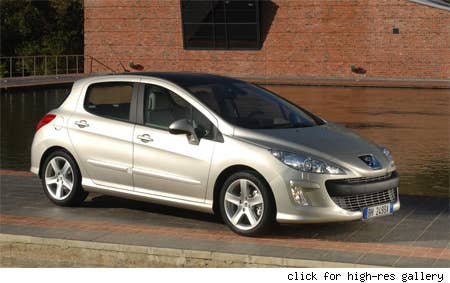
It doesn’t yet have a hybrid powertrain that will give it 70+mpg (but that option is coming), but Peugot’s new 308 does have a lot of options in the engine bay. The new 308, coming to the UK in September, has ten powerplant choices, with the lightest emitter sending out just 120 g/km of CO2. This aerodynamic little hatchback has got a below-average drag coefficient of just 0.29.
Aside from the talk of the diesel hybrid drive in one of these things, the best upcoming change is this: Peugeot says the 308 will evolve into a few different body shapes over the coming months and years, and there will be a “BioFlex” petrol model introduced at some point. Should be able to knock that 120 number down to double-digits one of these days.
You can peep the full list of powerplant options in the press release after the jump.
Featured Gallery

Here are our choices for the Top 12 new or redesigned vehicles that will be arriving in showrooms this year.
Everyone knows that the last two years have been a brutal period for automakers, with bankruptcies in Detroit and total sales volumes in a seemingly endless downward spiral. But things are beginning to look up this year, partly because car companies have been listening to buyers more than ever.
Both foreign and domestic manufacturers are rolling out new and redesigned models to give buyers more of what they’ve been asking for: improved fuel economy, more hybrids, more luxury amenities, zippier coupe editions of popular sedans, and smaller Euro-style models.

Luxury-sport-performance enthusiasts have been drooling over this one: The CTS coupe will start to arrive in showrooms this spring, while the CTS-V is scheduled to hit showrooms in early summer. Interestingly, the new CTS coupe will share very few components with the sedan, although it will be built on the same platform. The coupe will be powered by a 304-hp 3.6-liter V6, while the high-performance CTS-V gets its muscle from a supercharged 6.2-liter V8 that unleashes 556 stallions. Some of the advanced features will include doors with touchpad entry rather than handles, and center-outlet twin exhaust pipes.
Price:Estimated at $40,000-$50,000 (CTS); $65,000 (CTS-V)
Cadillac
For its stylish new midsize ragtop, which arrives in showrooms this month, Mercedes chose to go with the classic fabric top, which means the vehicle will be lighter than the BMWs, Lexuses and Infinitis that have gone to retractable hardtops. Mercedes says the top can be opened or closed in about 20 seconds, even while the vehicle is in motion, at speeds of up to 25 mph. The E350 will be powered by a 268-hp, 3.5-liter V6, and the E550 will get power from a 382-hp, 5.5-liter V8. Both will be hitched to a seven-speed automatic tranny. The trunk of the E-Class convertible offers 17 cubic feet of luggage space when the top is up, and 13.8 when it’s down.
Price: Unknown, but likely to be $58,000 to start
- Research the Mercedes-Benz E-Class
- 2010 Mercedes-Benz E-Class Overview
- 2010 Mercedes-Benz E-Class Pictures
- Free 2010 Mercedes-Benz E-Class Price Quote

These are BMW’s first, hotly anticipated forays into hybrid territory, and they’re due in dealerships during the early part of the year. The X6 Hybrid will deliver 480 hp with its combination of a twin-turbo V8 and an electric motor. BMW is boasting that the 7 Series Hybrid will be the world’s fastest hybrid, with the twin-turbo V8 and electric motor cranking out 455 hp and a 0-to-60 time of 4.7 seconds. Buyers will pay dearly for these performance hybrids, however, as prices will reportedly start at $88,900 for the X6 and $102,300 for the 7 Series.
Price: $88,900 (X6 Hybrid); $102,300 (7-Series Hybrid)
BMW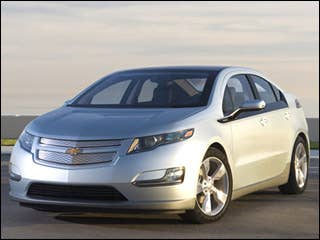
This long-awaited electric-powered vehicle hits showrooms late in the year, and will employ a lithium-ion battery pack and a 1.4-liter, four-cylinder engine. It’s a four-passenger hatchback that’s been designed so that if you drive beyond the 40-mile range of the battery, the gas engine kicks in to generate more electricity. The Volt has “grown up in public,” so to speak, since it debuted as a concept at the 2007 Detroit auto show. The three-plus years since have sen much hand wringing over its launch schedule, range and reliability, but GM has a lot riding on the Volt, so you can be sure that the company has thrown every resource at its disposal behind the project.
Price: Estimates in the low-to-mid $30s, including the Federal tax credit

Arriving in showrooms late in the year, this upsized, shapely beauty builds on previous editions, but it’s more spacious, more stylish, and offers better performance than before. It will be powered by a 372-hp, direct-injected, 4.2-liter V8, mated to an eight-speed automatic transmission. Audi is saying the revamped model will offer a 15 percent improvement in fuel economy over the previous edition, which is EPA-rated at 16/23 mpg city/hwy. The interior will also be more luxurious than ever, with bountiful wood and leather trim. A new navigation system offers Multi Media Interface Touch, a system that recognizes handwritten instructions on a touch pad.
Price: Likely in the mid-$80,000 range to start
- Research the 2010 Audi A8
- 2010 Audi A8 Overview
- 2010 Audi A8 Pictures
- Free 2010 Audi A8 Price Quote

The Cruze compact sedan, due in the fall, is a success story in Europe and Asia, and GM is obviously hoping its reception here is just as enthusiastic. The company wants and needs to sell more fuel-efficient vehicles, and the Cruze will help, getting 40 mpg on the freeway. It should still deliver some zip, thanks to a turbocharged, 140-hp, 1.4-liter four-cylinder engine that can be mated to either a six-speed automatic or manual trans. A 1.8-liter engine will also be available. The Cruze will provide almost as much passenger space as a midsize sedan, and will also offer 10 airbags, a navigation system and electronic stability control with rollover sensors.
Price: Estimated to start in the mid teens
General Motors
This handsome, large, luxury sedan is Hyundai’s “upscale move,” following on the heels of the successful premium midsize Sonata that arrived in showrooms in January. The Equus is due in the U.S. late in the year, an already popular model among the executive set in Korea. The model for America will offer a 4.6-liter V8 good for 378 horsepower and include such nifty features as seats that read how hot, cold or humid you’re feeling and adjust temperature accordingly.
Price: Unknown, but likely $50,000 and up
Hyundai
This subcompact, available as either a sedan or hatchback, is slated for a summer arrival. Fiesta boasts highway fuel economy of 40 mpg, reflecting Ford’s “global design” philosophy of selling the same vehicles here as in Europe and elsewhere. Both the sedan and the hatchback will get power from a 119-hp, 1.6-liter four-cylinder engine, which can be hitched to either the PowerShift six-speed automatic or a conventional five-speed manual transmission. Features will include push-button start and Sync, the onboard, voice-activated communications and entertainment system.
Base Price: $13,320
- Research the 2011 Ford Fiesta
- 2011 Ford Fiesta Overview
- 2011 Ford Fiesta Pictures
- Free 2011 Ford Fiesta Price Quote
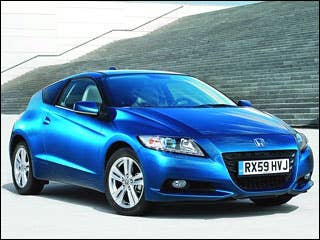
A sporty compact hybrid, the CR-Z recalls the popular‘80s-era Honda CRX, both body design and “fun-to-drive” characteristics. But the CR-Z benefits from modern-day technologies, combining an electric motor and a 1.5-liter, four-cylinder engine to deliver 122 hp. With a standard six-speed manual transmission, Honda is hoping the car is more enticing to green-minded enthusiasts drivers than the vanilla Honda Insight hybrid. Estimated fuel economy with the manual trans will be 36/38 mpg, city/hwy. A Continuously Variable Transmission (CVT) is also an option.
Price: Unknown, but likely in the $20,000 range
Honda
This luxury crossover has boasted high-style accoutrements since its inception a few years ago, and the 2011 edition gets a load of updates, from freshened styling to advanced-tech gadgets to a new power plant. Arriving this summer, the MKX’s 3.7-liter V6 boosts power output to 305 ponies. On the outside, the new model will get a split wing grille, new two-piece LED taillamps, revised wheel designs and four-inch oval exhaust tips. Other features include a radar-based adaptive cruise-control and automatic collision warning, blind-spot alert, and sensors that warn the driver if a vehicle is heading into the MKX’s path when it’s in reverse.
Price: Estimated around $40,000
- Research the 2010 Lincoln MKX
- 2010 Lincoln MKX Overview
- 2010 Lincoln MKX Pictures
- Free 2010 Lincoln MKX Price Quote
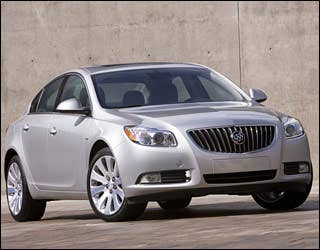
The revamped midsize Regal sedan will be in dealerships this month, and its new profile will be sportier, part of GM’s plan to lure younger buyers to Buick. The hope is to compete with foreign luxury sport sedans like the Acura TSX and Volvo S60. Buyers can choose between two four-cylinder engines, a 182-hp, 2.4-liter, direct-injected job that will get an estimated 30 mpg on the freeway, and a turbocharged, 2.0-liter that delivers 220 hp and an estimated 29 mpg. Six-speed manual and automatic trannys are both available, as is a driver-adjustable suspension.
Base Price: $26,245
- Research the 2011 Buick Regal
- 2011 Buick Regal Overview
- 2011 Buick Regal Pictures
- Free 2011 Buick Regal Price Quote

Due in dealerships presently, the upgraded, burlier 2011 model adds a new 412-hp 5.0-liter V8 in the GT that boasts a higher compression ratio, yet still scored an EPA rating of 25 mpg on the highway. Buyers will also have the option of a 3.7-liter, direct-injection V6 that delivers 305 ponies and gets 30 mpg on the freeway. Each engine can be mated to a six-speed manual or automatic transmission. Electric power steering has been added to improve fuel economy and steering response, and the suspension will be beefed up with upgraded springs and dampers. Plus, a new rear control arm setup will help deliver a smoother ride.
Base Price: $22,145
- Research the 2011 Ford Mustang
- 2011 Ford Mustang Overview
- 2011 Ford Mustang Pictures
- Free 2011 Ford Mustang Price Quote
[Source: Peugeot]
PEUGEOT 308 – INSIGHT INTO A NEW MODEL
- To be launched in September 2007
- Powered by seven engine options
- Class leading aerodynamics
- 1.6 litre HDi 90 emits only 120 g/km of CO2
- The start of a new “3” series family
Peugeot’s first vehicle of the “8” generation, the Peugeot 308 five door hatchback will be launched in the UK in September.
Designed by Peugeot’s in-house designers, the Peugeot 308 builds on the successful concept of the Peugeot 307, with its semi-high architecture, large interior space, class leading safety equipment and high standards of road holding.
The stylish design not only looks good but contributes to reducing fuel consumption and emissions, due to its class leading aerodynamics – Cx of 0.29 – enabling the 1.6 litre HDi 90 to emit only 120 g/km of CO2.
The Peugeot 308 will be available with 10 powerplant options:
Petrol engines *VTi – Variable valve lift and Timing and injection
- 1.4 litre VTi* 95 bhp 5-speed manual gearbox
- 1.6 litre VTi* 120 bhp 5-speed manual gearbox
- 1.6 litre VTi* 120 bhp 4-speed automatic gearbox
- 1.6 litre THP 150 bhp 5-speed manual gearbox
- 1.6 litre THP 140 bhp 4-speed automatic gearbox
HDi Diesel engines
- 1.6 litre HDi 90 bhp 5-speed manual gearbox
- 1.6 litre HDi 110 bhp 5-speed manual gearbox
- 1.6 litre HDi 110 bhp 6-speed controlled manual gearbox
- 2.0 litre HDi 136 bhp 6-speed manual gearbox
- 2.0 litre HDi 136 bhp 6-speed automatic gearbox
(*15 inch wheels)
Safety is another strength of the new Peugeot 308, with seven airbags fitted as standard; even rear side airbags will be available as an option on 5 door models. Peugeot’s lane departure warning system (LDWS) and bi-xenon directional headlamps will also be available.
The increased size compared to the 307 results in greater interior space and carrying capacity. The boot of the 308 is cleverly laid out to maximise the space which, with the parcel shelf in place provides 430 litres, increasing to 1,398 litres with the seats folded.
The Peugeot 308 will evolve into a number of different body shapes over the coming months and years, and will see a “BioFlex” petrol model introduced. It could also one day benefit from Peugeot’s HDi Hybrid technology.
The Peugeot 308 will go on sale in the UK in September 2007; price and specification details will be announced nearer the launch date.