
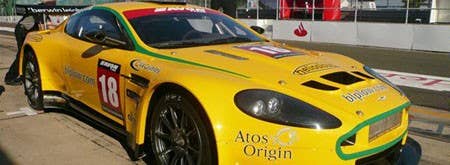
Last year, Barwell Motorsport’s bio-ethanol powered Aston Martin DBRS9 proved green fuels can be competitive in racing. That success did not go unnoticed, and Cadena Motorsport will follow in Barwell’s footsteps, converting its yellow DBRS9 to run on the greener juice as well. The British GT Championship’s website caught up with Cadena drivers Barrie Whight and Gavan Kershaw. Whight says Aston Martin’s racing partners see the use of green fuels as very attractive because it improves their corporate environmental responsibility. It’s likely to only get better, too, as other major series like the ALMS help encourage further innovation by embracing green racing initiatives. The bio-ethanol conversion for the Cadena DBRS9 is underway and should be finished by the end of this month.
You may also recall that in January, Aston Martin Racing announced that its new Vantage GT2 racer would also be E85-capable. And lest you think the Aston Martin biofuel migration is exclusive to modern racers, one of the entrants in the 2008 New York-to-Paris “Great Race” is a vintage ’67 Aston Martin DB6 converted to run on E85. It’s no secret that automotive technology is often tested on the racetrack before making its way into passenger cars. Maybe the well-heeled (and James Bond) will be cruising in bio-fueled roadgoing Astons in the not-too-distant future.
Featured Gallery
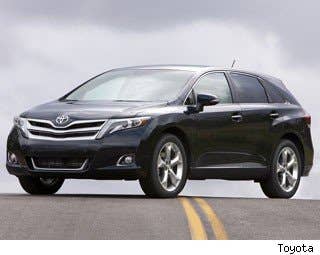
The Toyota Venza has always felt like an amalgamation of the company’s other, more successful vehicles.
It’s as if designers deconstructed the latest versions of the RAV4, Sienna and Highlander and built one car from the jumbled parts. In actually, the crossover Venza is based on the Camry. While all four of those vehicles have been highly successful, the Venza has stalled.
Through September, Toyota has sold 31,414 this year, roughly a quarter of the number of its longer-tenured siblings.
It’s easy to sense why consumers might be hesitant to purchase one. On one hand, the Venza, refreshed for 2013 models, possesses the athleticism of a minivan, borrows the sportiness of a Camry and suffers the seating limitations of a two-row crossover.
On the other, the Venza boasts the cargo space and towing capability of an SUV, represents an antidote to customers who loathe minivans and it possesses a practical sensibility in its handling. These factors and more make the Venza worthy of more attention from car shoppers.
At its heart, it’s a fundamentally sound car searching for an identity.
Here’s more on what we thought about the Venza.
Research the Toyota Venza
Toyota Venza Photos & Information
Toyota Venza Best Deals
Toyota Venza Local Dealer Price Quote
MSRP: $27,700 to $38,870
Invoice: $25,436 to $35,371
As Tested: $34,630
Research the Toyota Venza
Toyota Venza Photos & Information
Toyota Venza Best Deals
Toyota Venza Local Dealer Price Quote
– 2.7L I-4 or 3.5L V6 engine
– 6-speed automatic transmission
– 181 hp @5,800 RPM or 268 hp @ 6200 RPM
– 20 mpg City, 26 mpg Highway
– Seats 5
– 70.2 cubic feet max cargo capacity
Research the Toyota Venza
Toyota Venza Photos & Information
Toyota Venza Best Deals
Toyota Venza Local Dealer Price Quote
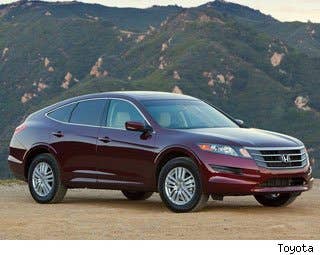
Ford Edge, Honda Crosstour (pictured), Nissan Rogue, Chevrolet Equinox, Honda CR-V, GMC Terrain
Research the Toyota Venza
Toyota Venza Photos & Information
Toyota Venza Best Deals
Toyota Venza Local Dealer Price Quote
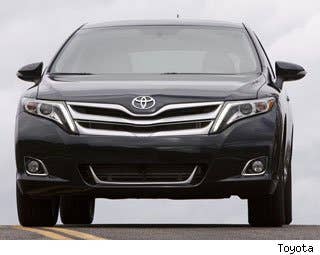
Pete: It’s not every day that the opportunity arises to test a vehicle under unplanned conditions. Once in a while, it comes along.
I was driving the Venza in the highway’s right lane when the driver in front of me slammed on his brakes for some unknown and inexplicable reason. Faced with a split-second decision to follow suit or switch lanes, I moved to the center lane with a tractor-trailer bearing down. The accelerator met the floor. The Venza delivered.
With all of its 268 horses galloping, I was speeding far ahead in a matter of seconds. What could have been a close call was instead a non-event. The Venza had showed some mettle. More generally, it proved itself a reliable vehicle for a commute filled with a variety of conditions throughout the drive.
The interior is, with one exception, comfortable. It’s a roomy vehicle that not only technically fits five, but probably can comfortably fit five reasonably-sized adults. There is ample storage near the front seats. Regular console space is supplemented by additional space underneath the cup holders.
Autoblog: The Venza’s 268-horsepower V6 never felt strained and its six-speed automatic transmission was a model of certainty, never hunting around for the right ratio. The driveline seemed utterly relaxed at all times, and pulling out to dispatch semi-trucks on long inclines was never an issue.
Research the Toyota Venza
Toyota Venza Photos & Information
Toyota Venza Best Deals
Toyota Venza Local Dealer Price Quote
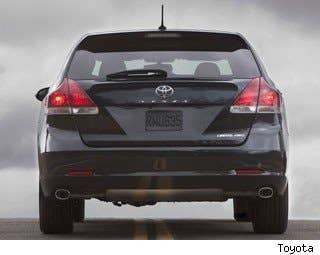
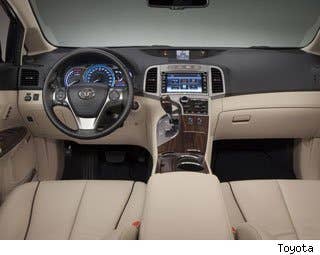
The dashboard needs an overhaul.
The gearshifter is neither mounted to the center console nor the steering wheel. Instead, it’s located in the lower-center portion of the dash – a placement that is awkward. There are preset seat-position buttons where a driver might expect to find window controls. Worse, the engine and fuel gauges look cheap and chintzy.
The headrest is remarkably uncomfortable. This car part might be the vehicular equivalent of offensive linemen in the NFL– it never gets noticed unless there’s a problem. While I can’t remember a headrest standing out in any capacity before, this one brings dubious attention.
Autoblog: The faux wood trim on our model’s center console had an almost matte finish, yet the “matching” parts on the armrests were rendered in a comparatively high-gloss finish. The audio/navigation head unit was also slightly misaligned, as were other visible trim pieces. … None of these issues truly dented our enjoyment of the Venza’s functionality, but … we’ve been raised to expect better attention to detail.
Research the Toyota Venza
Toyota Venza Photos & Information
Toyota Venza Best Deals
Toyota Venza Local Dealer Price Quote
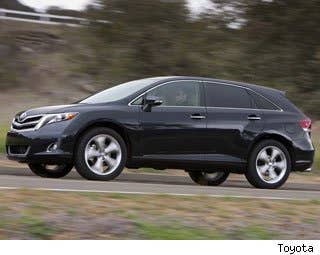
There’s a lot to like about the Venza, particularly with the V6 trims.
A potential buyer has limitless options with this vehicle. Haul a camper? It’s got a towing capacity of 1,000 pounds standard or 3,500 pounds in the V6. Road trip? There’s ample room for kids in the back and 70.2 cubic feet for gear. Fuel economy? The 20 mpg city, 26 mpg highway isn’t great, but it’s in line with the rest of the crossover segment.
Assert itself in traffic? It’s got the power.
The Venza is a satisfactory ride that’s a jack of all trades. That may be part of its identity problem. If a customer wants a true crossover, why not go with the award-winning RAV4? If they want a family hauler, why not get the additional seating in the best-selling Sienna?
And in perhaps the most natural comparison of the three, if a customer wants a mid-size crossover, why not buy the well-regarded Highlander, which comes with nearly identical fuel economy and price tag?
Improvements needed to upgrade the interior should be easy enough to remedy for the Venza. The more difficult challenge for Toyota might be solving the competition from within.
Research the Toyota Venza
Toyota Venza Photos & Information
Toyota Venza Best Deals
Toyota Venza Local Dealer Price Quote
Featured Gallery


[Sources: British GT via Crash.net]