
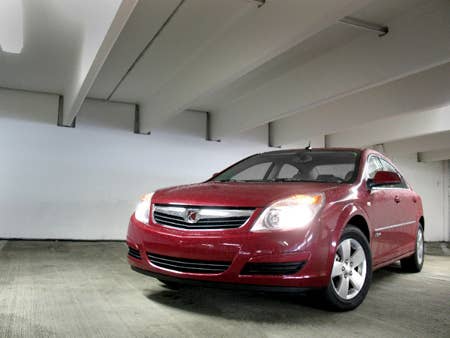
Click image for photo gallery
We recently spent a week with Saturn’s latest addition to the stable, the Aura Green Line, which afforded us the opportunity to size it up relative to its Aura XR sibling that we tested last year. The Aura XR was impressive, with attractive styling, some real pop underhood courtesy of the 3.6L V6, and a nicely-rounded, comfortable driving experience. A lot of he same basic good stuff carries forward to the Aura Green Line. Autoblog’s Aura Hybrid also looked pretty sharp and comported itself well overall. Follow the jump for a brief rundown of some of our observations of the Green Line compared to the XR, and keep an eye on AutoblogGreen in the coming days, as our colleague, Sam Abuelsamid, will be posting a complete full-length review of the car.
Featured Gallery

Sedans remain by far the most popular style of family car. It used to be that you would have to go up to the mid-sized level of sedan, such as Toyota Camry and Honda Accord, to get a respectable, well-equipped ride.
But no more. The quality of the sedans buyers can find priced under $20,000 has never been better. And just in the nick of time for car buyers challenged by the wobbly economy.
Consumers in need or want of a new car can respectably trade down from spending $25,000 or so to below $20,000 and not give up very much.
It is true that some true-mid-sized sedans, such as Kia Optima and Volkswagen Passat actually start their sticker prices below $20,000. The Passat, for example, starts at $19,995 if youprice it on AOL Autos. But, realistically, these cars wind up costing thousands more by the time they are properly outfitted and destination charges are applied.
So, we are sticking to sedans priced legitimately under $20,000 by the time you drive them away. And we have applied come up with a Top-Five ranking based on our knowledge of the vehicle’s quality, diving dynamics, aesthetics, value and track record.
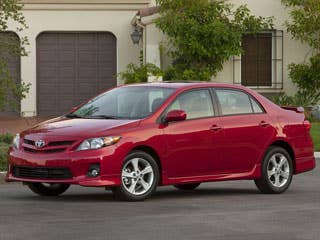
MSRP: $16,130 – $17,990
Invoice: $15,243 – $16,674
Fuel Economy: 27 mpg City, 34 mpg Highway
The Corolla virtually defines durability and consistency in the compact sedan category. The current Corolla is well-equipped with disc brakes on all four wheels, a robust offering of both a 1.8 liter, 132-horsepower engine or a 2.4 liter 4-cylinder engine. The more robust XRS version will be an easier trade-down from the mid-sized class for some people. Leather upholstery is available too.
Research the Toyota Corolla
Toyota Corolla Photos & Information
Toyota Corolla Specs
Toyota Corolla Local Dealer Price Quote
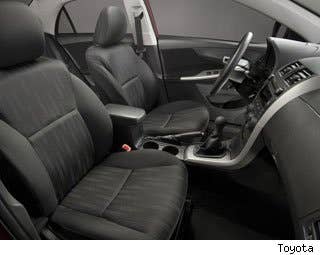
The back seat is fairly accommodating – the Corolla’s not the subcompact it once was – and a flat floor across the rear enhances the spacious vibe. The usefully large trunk capacity can be expanded by folding down the rear seatbacks, and elsewhere inside are two gloveboxes, large door cubbies, and an also-capacious storage bin in the center armrest. As a car for the everyman, the Corolla hits all the right notes.
Research the Toyota Corolla
Toyota Corolla Photos & Information
Toyota Corolla Specs
Toyota Corolla Local Dealer Price Quote

MSRP: $15,200 – $23,400
Invoice: $14,543 – $21,910
Fuel Economy: 25 mpg City, 33 mpg Highway
We are big fans of the Mazda3’s handling and driving fun. It may feel a bit stiff for some drivers, but we like that.
The 2012 Mazda3 comes with a Skayctiv option, which is a 2.0 liter, four-cylinder gas engine rated at 155 horsepower and 148 lbs. feet of torque. It comes in both manual transmission and automatic. The 3 lacks a USB jack for iPod/iPhone and similar devices, which is a bummer. But you can at least pair a phone via Bluetooth hands-free link.
Research the Mazda3
Mazda3 Photos & Information
Mazda3 Specs
Mazda3 Local Dealer Price Quote

Pricing is a little complicated here. The least expensive Skyactiv model is Sport sedan with six-speed manual transmission, which costs $19,245 including $795 shipping. The least expensive non-Skyactiv, which has less standard equipment, is the SV sedan at $15,995.
The Skyactiv version of the car is expected to get 38-40 mpg on the highway. Combined fuel economy is 31-33 mpg. We got a little shy of that.
Even with a few complaints on features, we still like the way the Mazda3 drives for daily enjoyment.
Research the Mazda3
Mazda3 Photos & Information
Mazda3 Specs
Mazda3 Local Dealer Price Quote

MSRP: $16,500 – $22,700
Invoice: $15,635 – $21,112
Fuel Economy: 26 mpg City, 36 mpg Highway
The styling of the new Focus is light years better than the old model, and now a category leader in our opinion. The sporty front fascia, multiple wheel package combination, sleek, sculptured side views. It’s all good with us.
Seating material aside, the Focus uses stylish, easy-to-read gauges that are supplemented by a small LCD screen nestled between the tachometer and the speedometer. The screen can be set up to display everything from fuel economy to your trip meter, average speed and a host of other information.
Research the Ford Focus
Ford Focus Photos & Information
Ford Focus Specs
Ford Focus Local Dealer Price Quote

Ford has priced the 2012 Focus Sedan starting at $16,995 in S trim, though opting up to the five-door in SE guise will set you back $18,790. If your pockets are a little deeper and you like the look of the more polished interior, Titanium trim will go for $22,995 for the sedan.
Driving fun is not as high as Mazda3, but we like the extra niceties in the Focus, which is a better overall package than either the Mazda3 or Toyota Corolla on our list.
With available goodies like MyFord Touch and a hatchback body style if you want, the Focus also delivers more than Honda Civic.
Research the Ford Focus
Ford Focus Photos & Information
Ford Focus Specs
Ford Focus Local Dealer Price Quote
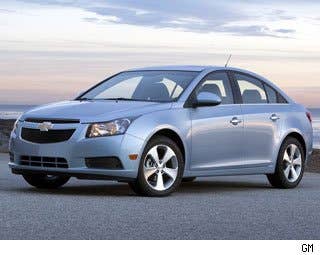
MSRP: $16,800 – $23,190
Invoice: $16,212 – $22,146
Fuel Economy: 25 mpg City, 36 mpg Highway
Until the Chevy Cruze debuted in 2010, we wondered if Chevrolet was ever going to take the compact-car category seriously. The last offering, the Cobalt, was dreadful and seemed worthy of Chinese highways, but not American.
The exterior of the Cruze is a little conservative, but we can forgive that when we consider what a good package the whole car is inside and out.
In LTZ trim, the dash is dominated by a tech-laden but well-sorted center stack and accented with broad swaths of leather. We’re not talking vinyl with real leather grain here, either. GM has also done a great job of making sure that nearly anyone can fit behind the wheel– and we do mean anyone. The driver’s seat can be positioned so far back that someone of normal height will have no chance of reaching the pedals or the steering wheel.
Research the Chevrolet Cruze
Chevrolet Cruze Photos & Information
Chevrolet Cruze Specs
Chevrolet Cruze Local Dealer Price Quote

Cruze is offered in a few engine combinations: a 1.8 liter four cylinder engine producing 136 hp, 1.4 liter turbo-charged four cylinder and the Cruze Eco, which has the 1.4 liter Turbo engine in both manual and automatic transmission. But Chevy cut weight out of the normal Cruze, lowered the stance, added low-resistance tires and more carefully managed airflow so the car glides through the air easier. Highway mileage is 42 mpg, tops for a non-hybrid or diesel car. We have actually scored 48 mpg in testing.
The Eco costs $1,450 more than a similar non-Eco Cruze: $19,175 with destination charges for manual transmission, and $20,625, automatic.
Research the Chevrolet Cruze
Chevrolet Cruze Photos & Information
Chevrolet Cruze Specs
Chevrolet Cruze Local Dealer Price Quote

MSRP: $15,345 – $20,595
Invoice: $14,918 – $19,727
Fuel Economy: 29 mpg City, 40 mpg Highway
As much as we like the Chevy Cruze, and were tempted to call it a tie between that car and the Hyundai Elantra, we opted to give it to Elantra by a nose. We had support, too, as a jury of North American journalists gave the Elantra its Car of the Year award for 2011.
Exterior styling is excellent, and, along with Ford Focus, has set a new standard in the compact sedan category.
For now, there are only two basic trim packages: GLS and Limited. In GLS guise, the interior of the sedan is treated with attractive cloth seats and a two-tone dash with soft-touch materials up top and well-grained plastic down low. In Limited configuration, the center stack is dominated by a massive seven-inch touch-screen that hosts controls for navigation, audio and iPod integration. Thanks to XM NavTraffic and NavWeather, buyers can check the status of everything from traffic congestion to stock prices, weather advisories and sports scores.
Research the Hyundai Elantra
Hyundai Elantra Photos & Information
Hyundai Elantra Specs
Hyundai Elantra Local Dealer Price Quote

One of the nicer details in the Elantra interior is the HVAC controls. Designers implemented an intuitive system of stacked dials to control fan speed and temperature, and the system takes little more than cursory glance in order to be able to use without taking your eyes off of the road. The dials feel like quality pieces with nice texturing and a solid action.
Regardless of what trim level buyers decide on, they’ll benefit from a drivetrain that returns 29 mpg city and 40 mpg highway. The 2011 Elantra comes with a 1.8-liter four-cylinder engine producing 148 horsepower and 131 pound-feet of torque. All told, the engine gives the 2011 Elantra more power and better fuel efficiency than competitors like the Honda Civic, Nissan Sentra, Toyota Corolla and Mazda3.
Elantra is the best total package and best sedan pound for pound, dollar for dollar under $20,000.
Research the Hyundai Elantra
Hyundai Elantra Photos & Information
Hyundai Elantra Specs
Hyundai Elantra Local Dealer Price Quote
The Aura Green Line combines the the same mild hybrid system and 2.4L Ecotec engine used in the Vue Green Line that we reviewed last year. Good for 164 horsepower, it’s paired with a 4-speed auto (the paddle-shifted six-speed would be nice here, General) and moves the Aura around ably. When warranted, the car gets an electric boost to help out with acceleration. It’s no match for the XR’s 3.6L V6, which is smoother, quieter, and much more powerful, but that said, the Green Line powertrain lets the car perform well both locally and on the interstate. The little green “eco” light appears quite readily and will remain illuminated as long as you keep your right foot light on the throttle. It becomes a bit of a game while driving to see how long you can keep it going, and unlike the ’07 Vue Green Line, the Aura GL has an info center display in the gauge cluster that shows you both instant and average fuel economy. This means you can really keep tabs on how you’re doing, and see a number to correspond with the light on the instrument panel.
The EPA rates the Aura Green Line at 28/35 city/highway, and over the week, we averaged right around 25 mpg — just like we did with the Vue Green Line. The lowish number is probably attributable to yours truly’s hellish 30-mile-each-way commute in mostly stop-and-go traffic. While it really puts the stop/start system to work, it otherwise doesn’t play up to the Aura’s strength as an economical highway cruiser. That trait that became apparent when I used the car as my transportation to and from the Greenwich Concours last weekend. In contrast to my weekday commute, the 60-mile round trip each weekend day was a breeze, and over the two days, the car’s average fuel economy increased pretty quickly.
Our tester was equipped with the Preferred Package, which adds a power driver’s seat, wheel-mounted radio controls, and heated electric outside mirrors. The cloth seating surfaces are fairly generic-looking, but the seats themselves are very comfortable and supportive. Parents who’d like a leather seating option (it’s easier to keep clean) are out of luck: hides aren’t available in the Aura Green Line — a surprising omission, if you ask us. We also have to say that we found the light gray interior color to be on the boring side — this is a matter of personal taste, of course, but it just didn’t jibe well with the car’s attractive Berry Red exterior, in our opinion. The available tan fabric and trim is far more complimentary, and is what we’d choose if we were buying.
A passenger commented on the car’s backseat legroom and noted that the dugouts in the front seatbacks really make a difference in this respect. Trunk space remains ample, but some is sacrificed to make room for the car’s battery pack. One thing we mentioned when reviewing the XR is that the center storage bin’s lid and latches felt exceptionally flimsy, and we expressed concern over their ability to survive daily use. After driving the Aura Green Line, we can affirm that the bin’s lid really is an egregious piece of crap. The latch on this particular tester had become off-kilter and didn’t work properly. It’s this kind of thing that detracts from what is otherwise a perfectly good car that we genuinely like. Fix it.
You’ll find other hybrid sedans that top the Aura Green Line in terms of available equipment and fuel economy (think Altima and Camry), but the Saturn wins big in the window sticker competition, checking in at just $23,070 as tested. Throw in the $1300 federal tax credit it’s eligible for, and once again, you have a very appealing value package in a car wearing the square Green Line badge.
Stay tuned for much more on the Aura Green Line from AutoblogGreen.
UPDATE: The full In the AutoblogGreen Garage review has now been posted.
All photos Copyright ©2007 Alex Núñez / Weblogs, Inc.