
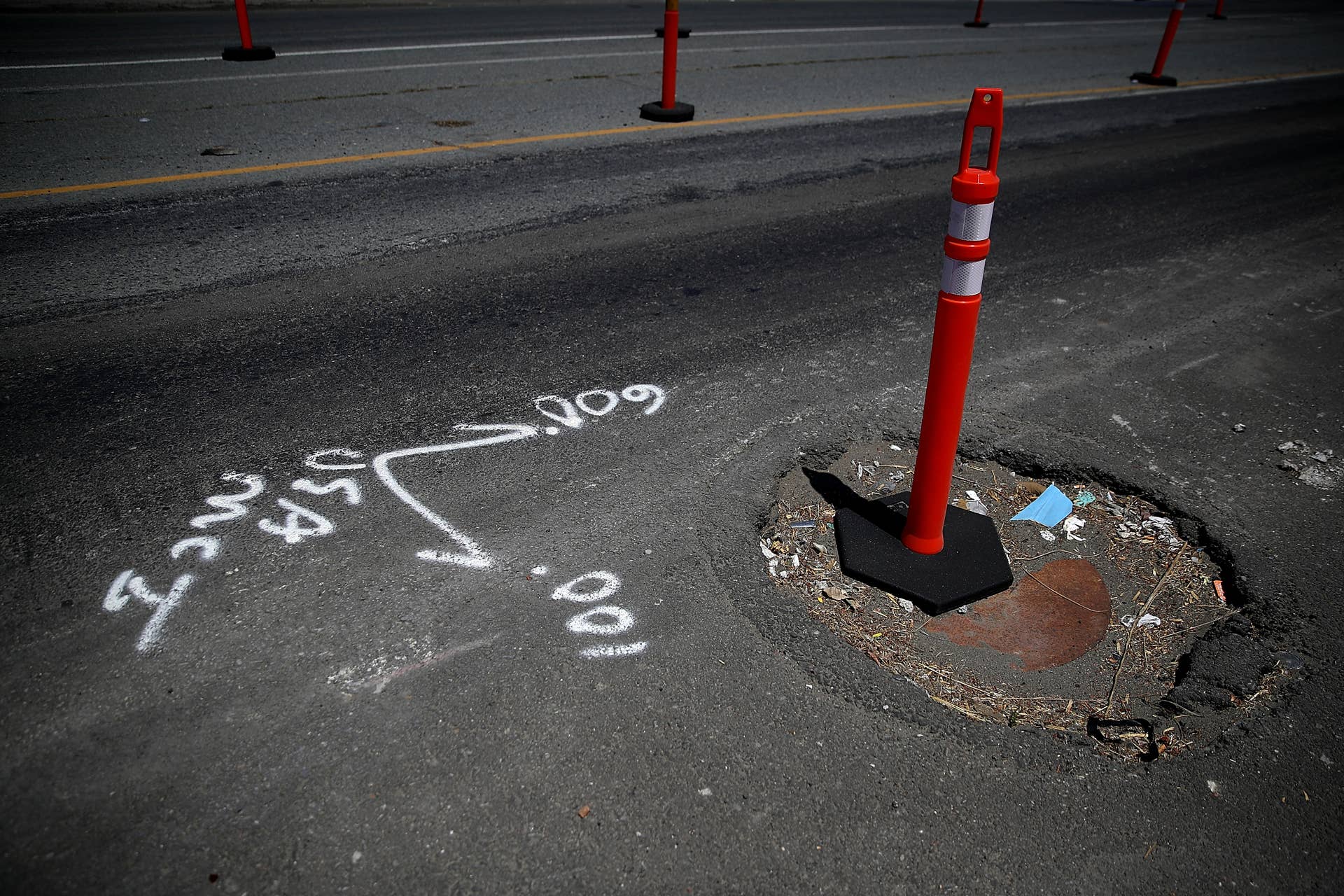
The “self-repairing city” isn’t expected to arrive until around 2050, but a team of engineers and scientists at the University of Leeds are programming the drones that will carry the building blocks. The group is halfway through an initial development phase for drones that will automatically mend city streets. The way it’s set up now, a scanning drone will spend nights searching roads for cracks and small holes, then send the coordinates to a second drone when issues are found. The second drone will arrive and 3D-print asphalt to repair the road, with some fixes taking less than a minute.
The project arose from a
$6.5 million grant to the University of Leeds by the UK’s Engineering and Physical Sciences Research Council (EPSRC) three years ago, part of a $32.5 million in funding to address “Engineering Grand Challenges.” The challenge envisioned three kinds of infrastructure drones: “perch and repair,” that would alight on and remedy tall fixtures like streetlights; “fire and forget,” which would live inside utility pipes performing inspections and overhauls (the oil industry already employs a distant relative of this, a technology
called “pigging”); and “perceive and patch,” the road-crew drones.
The key point about the road-going drones is that they’d be dispatched to repair cracks in the road
before those cracks become potholes. The benefit of using autonomous systems to maintain a self-repairing city is in being able to address concerns before they become problems. In this case, another benefit would be clearing the roads of equipment and shutdowns that impede the usual flow of the city. One of the scientists working on the project said, “We want to make Leeds the first city in the world to have zero disruption from street works.”
No one’s explained yet how the drones will 3D-print asphalt, nor how large a drone would need to be to support a useful asphalt payload. When the project began, many imagined a solution where a coordinated fleet of drones combined to carry the heavy materials. Engineers at
ETH Zurich programmed drones to work together to build a walkable rope bridge, and the
German Aerospace Center built a large drone with a flexible arm that could manipulate materials on its own.
The program has 2.5 more years to go, then we’re told they’ll begin trialing the road drones in Leeds. Program leaders envision the attempt as a social and cultural initiative, and want regulators and the public to weigh in on the work now, to consider potential societal issues. Said one professor, “Unless the public and policy-makers are involved right at the beginning of this technology, which is now, the chances of it advancing to the point where they feel excluded or
we can see a future that no one really wants is high.”
It seems Britain’s roads can’t wait for answers, though, and
local councils don’t have the means to keep up with the pace of disrepair. So perhaps we’ll have to wait until 2050 for the
answer to one commenter’s question, “Would there be other drones with shovels standing around?”
Related Video:
Video ID:
1bad6cc6-7a52-35d8-9491-5137e4950539
Playlist ID:
Autoplay:
false
Mute:
false
Continuous:
false
Ad Key:
Ad Value: