
Filed under: Etc., Safety, Tech
Elastic steel makes your car safer by stretching it out
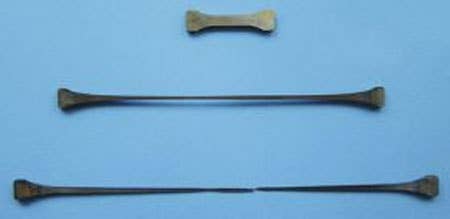
The Max Planck Institute for Iron Research and the German Steel Institute have developed a variety of steel that strengthens as it elongates. In the event of a car crash, the steel is ductile enough to absorb impact energy, but remains strong enough to protect occupants.
Called Twinning Induced Plasticity steel, the secret is that the steel passes the deformation energy down its length and to other parts, which also deform. The benefit is that with more area available to share the impact load, there is less that can reach the car's occupants. The institute mentions using the steel in bumpers and side doors, the most vulnerable areas in a crash.
Improved passenger safety is always good. Yet with more structures to inclined to deform, such a development would also seem to need new inspection techniques after a crash to make sure everything is still safe. Also, while the fracture point of the pictured steel is listed as 1,250-percent of elongation, it would need to be established how much elongation-before-fracture was still safe.
Thanks for the tip, Ben!
[Source: Physorg]
Reader Comments (Page 1 of 1)
Little Green Men 7:58PM (9/21/2007)
That sounds like U.F.O. technology to me. I guess all the abductions and anal probes have been well worth it if makes our cars safer. Remind me to put our space alien friends on my Christmas card list.
Reply
mavkato 11:59AM (9/22/2007)
post of the week :D
SPG 8:40PM (9/21/2007)
This sounds awesome.
I hope it works.
Reply
Dinger 11:18PM (9/21/2007)
Hey! That's an Aero not and SPG rim!
SPG 3:44AM (9/22/2007)
Nothing like an SPG with Aero rims.
In this case these rims are on a 9000 but I just wanted the Aero rim.
Good eye Dinger!
Barney 8:56PM (9/21/2007)
Once deformed, expensive to replace. I doubt the average body shop will ever put it back together again. If it protects the occupants better, the new steel will be worth it. BUT if the same has to be replaced in a minor accident, car repairs will be more expensive..
Reply
Jason Piotrowski 9:45PM (9/21/2007)
Too bad an accident doesn't stretch your car out, this might actually work.
All joking aside, this material actually could have great benefits in the applications listed such as bumpers and side structure where an impact tries to stretch the metal.
Reply
Keith Wakeham 9:51PM (9/21/2007)
This isn't amazing behaviour - Sorry to disappoint. Steel gets stronger as it deforms (who knew... oh wait, any engineer who has done any course in materials knew). But they have taken it to an extreme. Not trying to say thats its not a feat, just not the first time this was ever recognized because any book on steel shows this behavior, look up stress strain curve (engineering vs real is also interesting)
As for safety of a car after its been in an accident, It isn't the same if anything more than the body took damage. The only way of getting that chassis back to normal is to dissasemble, anneal, heat treat, and then reassemble every single welded item. The problem really arises when its "repairable" damage. They realign, reweld, cut, weld, shimmy, etc things until it looks normal, but I have yet to see an accident repair produce any destructive or non-destructive test results ever.
If it looks safe consumers will believe
Reply
Ryan 11:02PM (9/21/2007)
Fe-26Mn-3Si-3Al.... A steel mill can't/won't touch it although a process such as NUCOR's thin strip casting process may be able to make automotive sheet. Even with an as-cast microstructure, 60-70% elongation is easily attained. Generally, this alloy has to be cast as ingot and hot-rolled or forged. Georg Frommeyer is the PhD is Germany working on it and other related high Mn high Al alloys. He published this and a couple of other related articles a couple of years back. The TWIP's are especially nice as they respond well to high strain rate deformation at the crash relevant 10^2/s strain rate. At these conditions, they actually perform better the Ti-6Al-4V.
Reply
Ben 6:05AM (9/22/2007)
Man, Jonathon, you don't have to write about something if you don't know jack about it. If I cared about reading advertising nonsense, I'd go somewhere else.
I thought everybody knew that cold-working steel (deformation) makes it stronger, as well as all metals.
Reply